| Product Name | CODE | CAS No. | Product properties & Features |
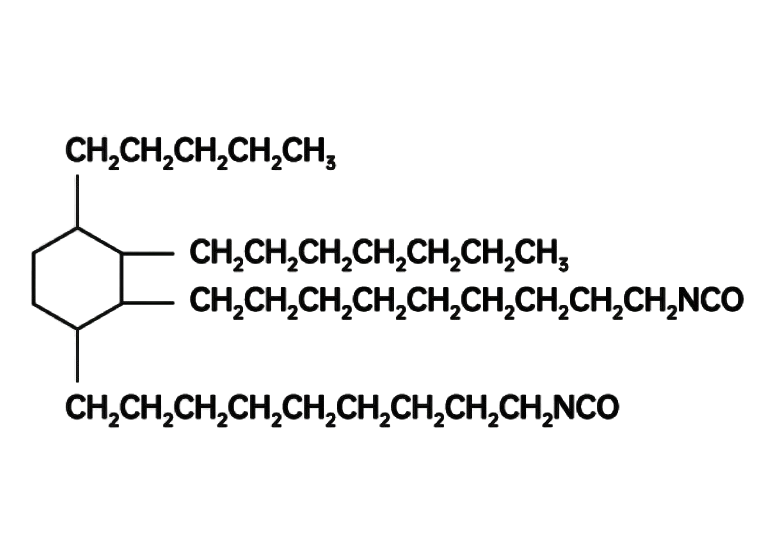
| Dimeryl Diisocyanate | DDI | 68239-06-5 | DDI is a unique aliphatic diisocyanate. It is a long-chain compound with a 36-carbon dimer fatty acid backbone. It has many advantages of non-yellowing, low toxicity, easy to use, soluble in most solvents, controllable reaction time and low water sensitivity. which can be widely used in fabric finishing, elastomers, adhesives and sealants, coatings, inks and other military and civil fields.
*Customized production can be operated.
|
| Tetramethylxylylene Diisocyanate | TMXDI | 2778-42-9 | TMXDI features a unique tertiary carbon diisocyanate structure. Compared to conventional primary/secondary carbon isocyanates, it offers outstanding advantages including precise reactivity control, high product elongation, excellent thermal and weather resistance, and low toxicity.
With extremely low reactivity toward self-condensation and carboxylic acids, TMXDI enables low-viscosity prepolymers without solvent dilution—making it an ideal choice for fully waterborne polyurethane systems.
Widely used in specialty coatings, waterborne polyurethanes, wood finishes, thermoplastic elastomers, sealants, adhesives, and RIM products. |
| 1-(1-Isocyanato-1-Methylethyl)-3-Isopropenylbenzene | TMI | 2094-99-7 | TMI features both reactive NCO and isopropenyl groups, offering dual functionality for vinyl copolymerization and NCO crosslinking. The NCO group is sterically protected by two adjacent methyl groups, ensuring relative stability in water and resistance to premature hydrolysis.
By incorporating NCO onto acrylic resin backbones, crosslinking with amino compounds occurs during film formation, significantly enhancing coating performance.
Widely used in latex modification, coatings, adhesives, one-component heat-curable resins, plastic surface modification, foams, and elastomers. |
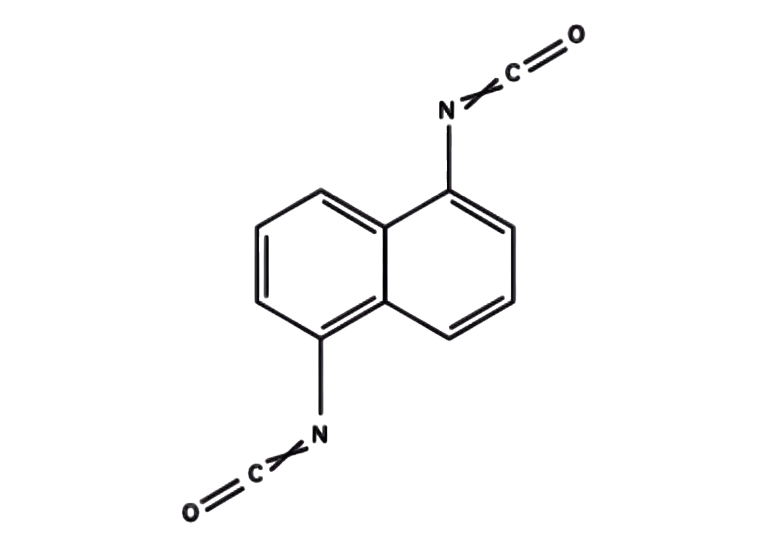
| cyclohex-1,4-ylene diisocyanate | CHDI | 2556-36-7 | The polyurethane elastomer based on CHDI is excellent in resilience, transparency, yellowing and weathering resistance, etc.
CHDI mainly used to produce polyurethane elastomers, adhesives, coatings, etc.
CHDI is widely used in the field of automotive, home livings, transportations, etc. |
| Trans-1,4-Cyclohexane Diisocyanate | Trans-CHDI | 7517-76-2 | Trans-CHDI features a compact and symmetrical molecular structure that forms well-ordered hard segments in polyurethanes. This imparts exceptional high-temperature dynamic mechanical properties (low heat build-up), light and color stability, solvent resistance, abrasion resistance, and hydrolysis stability. Softening temperature reaches up to 270°C, with a glass transition temperature as low as approximately -80°C.
Ideally suited for humid, oily, and high-wear/tear environments. Widely used in medical polyurethane elastomers (with dynamic performance and biostability), solid tires, high-temperature-resistant firefighter visors, automotive stop blocks, as well as seals, conveyor belts, hoses, coatings, and films. |
| Hydroxyl-Terminated Polybutadiene | HTPB | 69102-90-5 | Key Properties:
1. Hydrophobic with low moisture permeability 2. Reactive hydroxyl groups for versatile curing 3. Ultra-low glass transition temperature (≈ -80°C) 4. Excellent hydrolysis, acid/alkali, and low-temperature resistance 5. Superior wear resistance and electrical insulation 6. Strong adhesion to diverse substrates 7. Low-color, high-clarity viscous liquid
Primary Applications: - Coatings,Adhesives,Sealants,Potting and encapsulation - Propellant - Polyurethane(PU) elastomers - Electrical insulation materials - Rubber products - Polymer Modification etc.
*High output, steady supply, cost-effective quality, Customized production can be operated. |
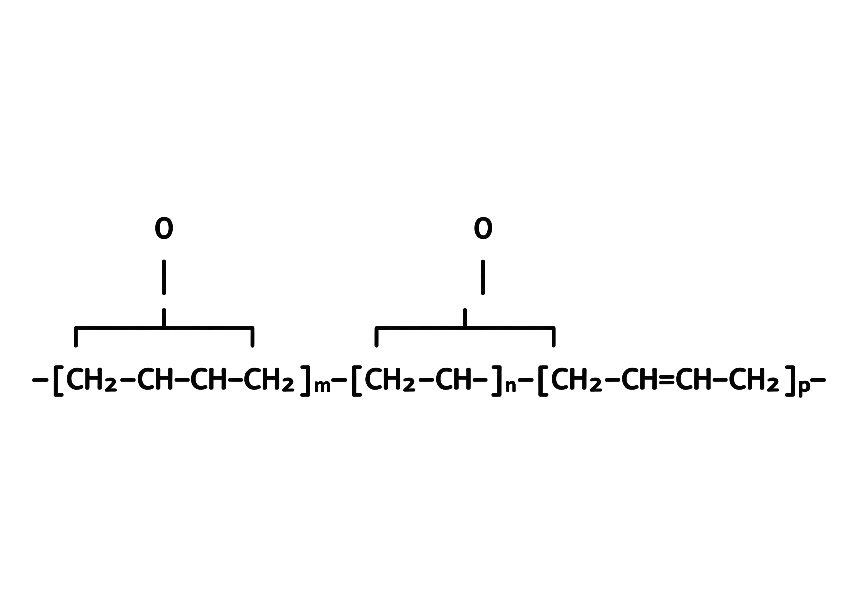
| Epoxidized Hydroxyl-Terminated Polybutadien | EHTPB | 71342-74-0 | EHTPB introduces epoxy groups onto the HTPB backbone, significantly enhancing molecular polarity while retaining reactive hydroxyl and double-bond functionalities. It offers excellent oil and aging resistance, high transparency, low viscosity, and outstanding low-temperature performance.
Dramatically improves mechanical properties, adhesive strength, and heat resistance of polyurethane materials—making it a key component for adhesives, sealants, coatings, and elastomers. Exhibits excellent compatibility with epoxy resins, good hydrophobicity, acid/alkali resistance, and strong adhesion to various substrates.
When used as a toughening agent for epoxy systems, EHTPB not only significantly enhances impact toughness but also imparts superior electrical properties to cured products.
*Customized production can be operated. |
| Carboxy-terminated Nitrile Butadiene Rubber | CTBN | 25265-19-4 | CTBN is a liquid nitrile rubber with carboxyl functional groups at both ends of its molecular chain. The terminal carboxyl groups can react with epoxy resin, providing an effective toughening effect on the epoxy resin.
CTBN can be used as:
- Adhesives, bonding, sealing, spraying, potting(aerospace, automotive, electrical/electronics, industrial. marine and construction applications...)
- Coatings (solution, powder, waterborne)
*Customized production can be operated. |
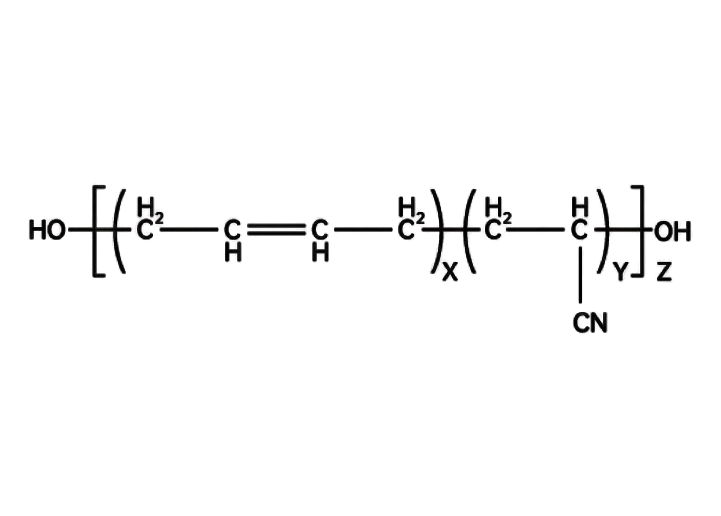
| Hydroxy-terminated Nitrile Butadiene Rubber | HTBN | 9003-18-3 | HTBN is a liquid nitrile rubber with hydroxyl functional groups at both chain ends. It retains the excellent oil, heat, and abrasion resistance characteristic of nitrile rubber, while offering efficient reactivity with isocyanate curatives and good processability with strong adhesion.
Primarily used in adhesives, coatings, and resin toughening—significantly enhancing the toughness, adhesion, durability, and oil/heat resistance of composite materials.
*Customized production can be operated. |
| Amine-terminated Nitrile Rubber | ATBN | 68683-29-4 | ATBN is a liquid nitrile rubber with amine functional groups at both chain ends. It can be cured with isocyanate curatives or react with epoxy groups. Exhibits excellent oil, heat, and abrasion resistance with strong adhesion. When used to toughen epoxy resins, it effectively reduces gelation and curing temperatures.
Primarily used for epoxy resin toughening—significantly enhancing composite toughness, shear strength, and peel strength. Can also be used alone as adhesives and sealants.
*Customized production can be operated. |
| Carboxyl terminated polybutadiene | CTPB | 586976-24-1 | CTPB is a liquid polybutadiene rubber with carboxyl functional groups at both ends of its molecular chain. The terminal carboxyl groups can react with epoxy resin, providing an effective toughening effect on the epoxy resin. Compared to CTBN, CTPB has lower viscosity, as well as better low-temperature performance and flexibility.
*Customized production can be operated. |
| Liquid Polybutadiene | LPB | 9003-17-2 | A highly reactive hydrocarbon resin with excellent hydrophobicity, superior dielectric properties, and outstanding processability—making it an ideal choice for 5G copper-clad laminates.
Widely applied in circuit boards, coatings, rubber seals, rollers, and more. |
| Liquid Butadiene Styrene Rubber | LSBR | 9003-55-8 | LSBR is a low-molecular-weight copolymer of butadiene and styrene (MW 2,000–10,000), offering excellent electrical insulation and robust physical properties.
Widely used in circuit boards, adhesives, sealants, and more. |
| Monohydroxy liquid polybutadiene | LPBOH | | LPBOH features a single hydroxyl group at one chain end, enabling dual curing via both hydroxyl and vinyl functionalities. Offers high reactivity, excellent hydrophobicity, superior dielectric properties, and good processability. |
| Hydroxy-terminated Butadiene-styrene Random Copolymer | HTBS | | HTBS is a liquid butadiene-styrene copolymer with hydroxyl groups at both chain ends. It offers excellent heat, wear, and aging resistance, good processability, low heat build-up, and outstanding low-temperature flexibility.
Compatible with natural and synthetic rubbers, and suitable for use alone in cast polyurethane tires, potting adhesives, sealants, and more. |
| Epoxidized Polybutadiene | EPB | 129288-65-9 | EPB introduces epoxy groups onto the polybutadiene backbone, offering oil resistance, aging resistance, good transparency, and excellent low-temperature performance.
The epoxy groups serve as reactive sites for curing with isocyanates or epoxy curatives, significantly enhancing mechanical strength, adhesion, and heat resistance in polyurethane systems. The polar nature also improves bonding to both metallic and non-metallic substrates.
Widely used in adhesives, sealants, coatings, epoxy toughening, and PU elastomers. |
| Medium Molecular Weight PET Polyether | PET Polyether | | Liquid at room temperature – easy to process. Tg as low as -80°C (–112°F) – exceptional low-temperature performance. Elastomer mechanical properties rivaling PTMG, with superior flexibility across a wide temperature range. Ideal replacement for PTMG in flexible artificial leather and inks. Also widely used in low-temperature adhesives, coatings, and PU elastomers. |
| Aluminium Powder | Al powder | 7429-90-5 | - Metallic Pigments
- Thermal Interface Material
- Solar Cell Conductive Paste
- Powder Metallurgy
- Chemical catalysis industry
- Thermal Spray
- Refractory Material
- 3D Printing
- Sputtering Targets
- HTPB / AP / Al propellant
*Customized production can be operated. |
| Boron Nitride | HBN | 10043-11-5 | Boron nitride (BN) consists of boron and nitrogen atoms, categorized into hexagonal BN (hBN), wurtzite BN (wBN) and cubic BN (cBN). Hexagonal boron nitride features graphite-like layered structure, presenting lightweight white powder with lubricity and hygroscopicity, also known as "white graphite".
Key Properties: - Excellent electrical insulation - High thermal conductivity - Outstanding chemical & corrosion resistance - Ultra-high temperature resistance - Superior lubricating performance - Good coating adaptability - Non-toxic |

 English
 English
  Spanish
  Russian
  Arabic
  French
  German
  Portuguese
  Turkish
  Dutch
Dutch  Polish
  Korean
  Vietnamese
  Indonesian