
 English
 English
  Spanish
  Russian
  Arabic
  French
  German
  Portuguese
  Turkish
  Dutch
Dutch  Polish
  Korean
  Vietnamese
  Indonesian

 Online Consultation
H-HTPB (Hydrogenated Hydroxyl Terminated Polybutadiene (Hydrogenated-HTPB) CAS No.68954-10-9 )
Hydrogenated Hydroxyl Terminated Polybutadiene
CAS No.68954-10-9
Code: Hydrogenated HTPB
Read More
Online Service

 Mobile/Wechat/Telegram: +86-18321679576
 WhatsApp:+86-13248126998
 Email:young@further-chem.com
Email:info@further-chem.com


Carboxyl-terminated butadiene-acrylonitrile
CTBN
CAS No. 25265-19-4
Chemical name: Carboxyl-terminated butadiene-acrylonitrile
Other name: Carboxy-Terminated Nitrile Butadiene Rubber
Code: CTBN
CAS No.: 25265-19-4
Product Description
CTBN (Carboxyl-Terminated Butadiene-Acrylonitrile) is a low-molecular-weight telechelic copolymer with a main chain composed of butadiene and acrylonitrile, featuring reactive carboxyl groups (-COOH) at both chain ends. it appears as a light yellow to amber transparent viscous liquid.
Molecular Structure Features
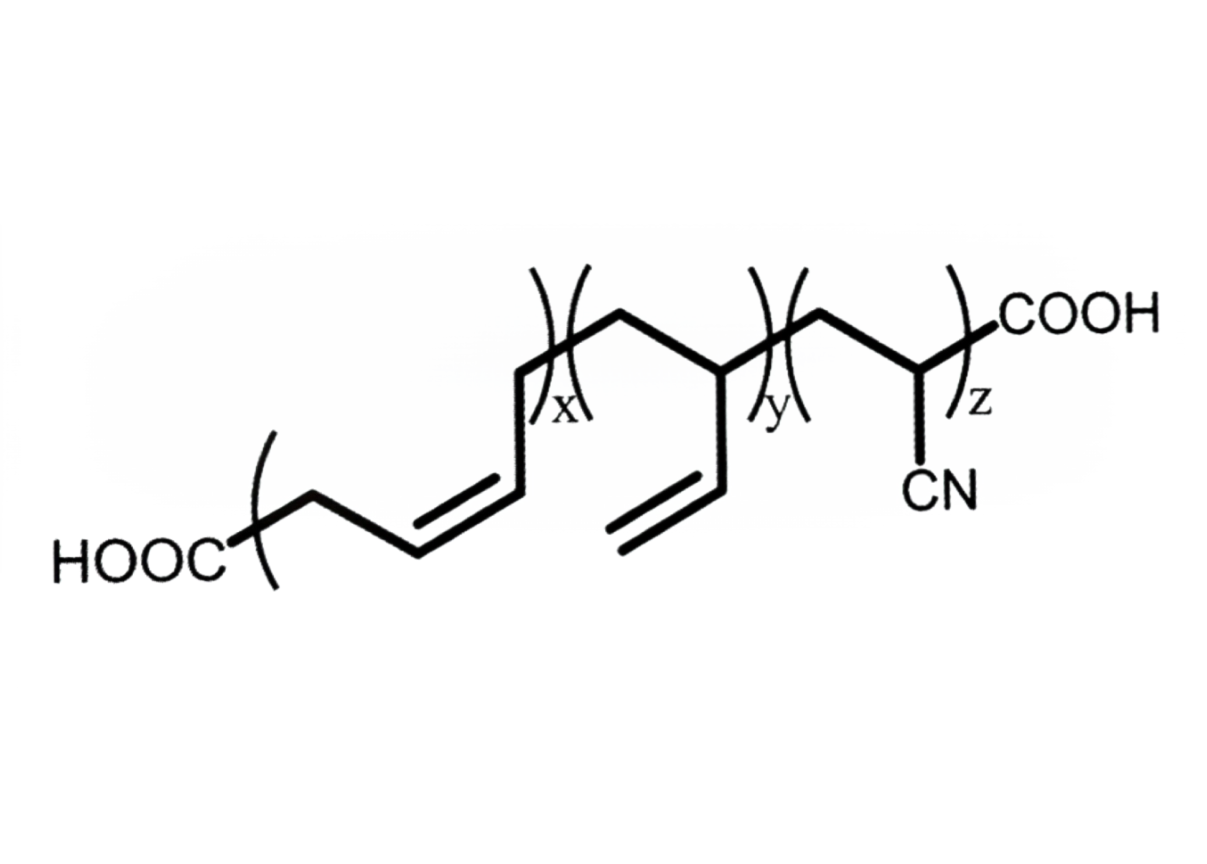
The CTBN molecule has a unique telechelic structure — reactive carboxyl groups at both ends with a butadiene-acrylonitrile copolymer main chain:
Butadiene units: Provide flexibility and low-temperature performance
Acrylonitrile units: Impart polarity, oil resistance, heat resistance, and enhance compatibility with polar resins
Terminal carboxyl groups: Can react with epoxy groups, oxazoline groups, etc., achieving chemically bonded toughenin
Product properties & Features
High-efficiency toughening & flexibility
Strong adhesion to difficult substrates
Superior impact & crack resistance
Excellent fatigue durability
High reactivity
Wide temperature tolerance (heat & low-temperature resistance)
Good chemical resistance
Excellent resin compatibility
Applications
Addition of 10%–15% boosts epoxy impact strength by 300%+, significantly reducing brittleness and improving crack and fatigue resistance.
Used in aerospace structural adhesives, electronic potting compounds, advanced composite matrices, wind turbine blade adhesives.
Metal/composite bonding: Enhances peel strength, humidity/heat resistance, oil resistance, and low-temperature toughness.
Adhesives: As abrasive binder for grinding wheels and cut-off wheels, it requires less binder and offers outstanding wear resistance, excellent polishing effect, as well as good resistance to hot water and cutting fluids.
Sealants: Oil-resistant seals, weld seals, wind power seals for automotive/construction machinery.
Bonding plexiglass and polyester tapes: significantly improved performance. This adhesive can also be applied for impregnation of various fabrics, including glass fiber, polyester and carbon fiber.
Serves as an energetic binder, improving propellant mechanical properties (elongation, low-temperature toughness) and processability.
Epoxy/phenolic coating modification: Improves impact resistance, abrasion resistance, salt spray resistance, and adhesion for heavy-duty anticorrosion, marine, pipeline, and automotive undercarriage applications.
Toughening of phenolic, BMI, and cyanate ester resins for high-temperature structural components, electronic packaging, and high-performance laminates.
Packing & Storage
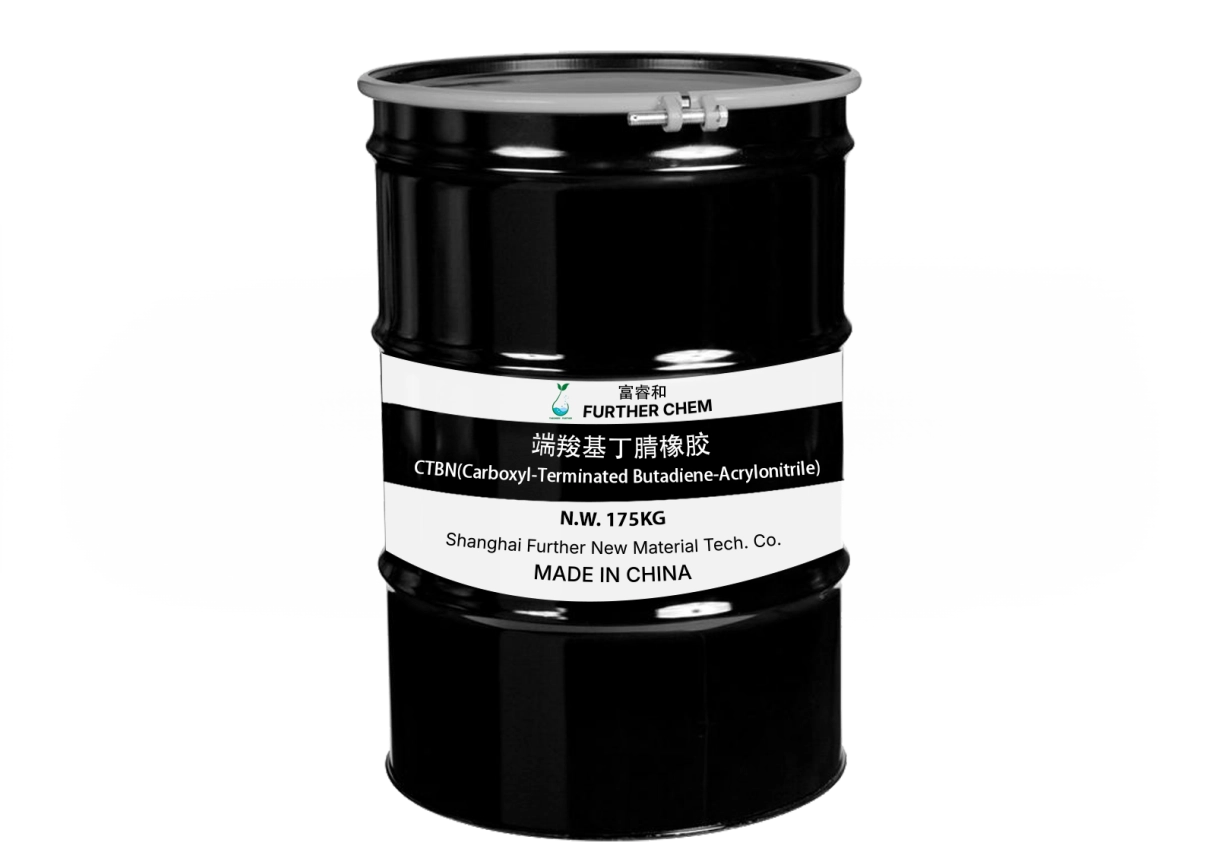
50kg/plastic drum or 170kg/metal drum packaging.
Storage should be cool, dry and ventilated.
The shelf life is 12 months, after the expiration of the re-inspection can still be used.
Avoid rain and sun during transportation. Do not mix with strong oxidants.
Technical Index
| Item | CTBN-1 | CTBN-2 | CTBN-3 | CTBN-4 | CTBN-5 |
| Carboxyl value(mmol/g) | 0.45-0.55 | 0.45-0.65 | 0.45-0.65 | 0.65-0.75 | 0.45-0.70 |
| Appearance | Amber Viscous liquid, no visible impurities | ||||
| Viscosity (27℃,Pa.S) | ≤180 | ≤200 | ≤300 | ≤200 | ≤600 |
| Acrylonitrile content,% | 8.0-12.0 | 8.0-14.0 | 18.0-22.0 | 18.0-22.0 | 24.0-28.0 |
| Moisture,wt% ≤ | 0.05 | 0.05 | 0.05 | 0.05 | 0.05 |
| Volatile Content,% ≤ | 1.0 | 1.0 | 1.0 | 1.0 | 1.0 |
| Molecular weight | 3600-4200 | 3000-4500 | 3000-4500 | 2500-3000 | 3000-4500 |
*NOTE: We are able to customize CTBN based on customers' intended applications and required specifications.
By submitting this form, you consent to the storage of your data and
your interests in order to answer your enquiry. Further
information
on data processing, your rights and revocation can be found in our
privacy policy.