 English
 English
  Spanish
  Russian
  Arabic
  French
  German
  Portuguese
  Turkish
  Dutch
Dutch  Polish
  Korean
  Vietnamese
  Indonesian

 Online Consultation
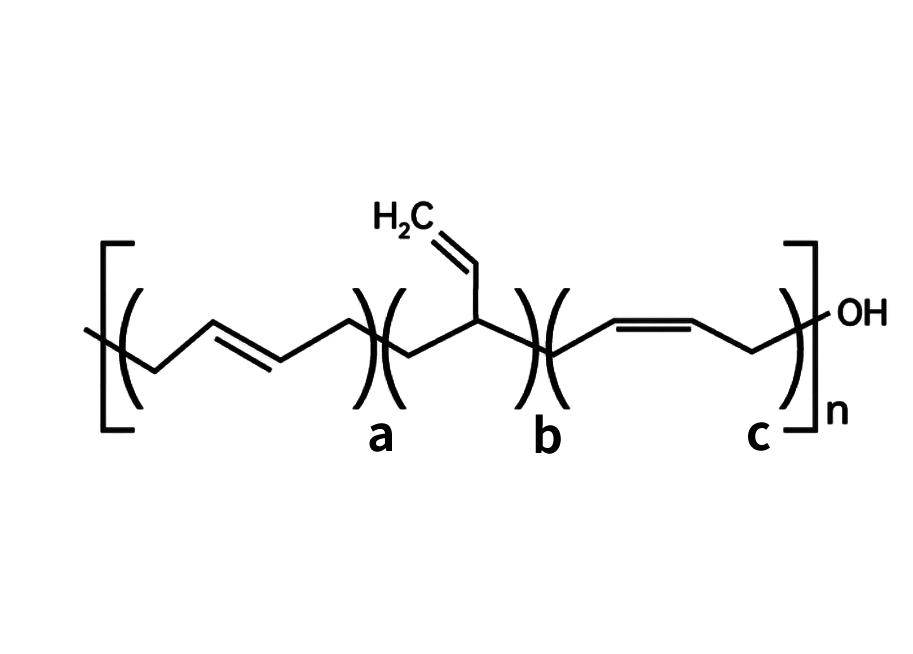
LPB (Liquid Polybutadiene )
Liquid Polybutadiene
LPB
Read More
Online Service

 Mobile/Wechat/Telegram: +86-18321679576
 WhatsApp:+86-13248126998
 Email:young@further-chem.com
Email:info@further-chem.com


Epoxidized hydroxyl-terminated polybutadiene
EHTPB
CAS No.129288-65-9
Chemical Name: Epoxidized hydroxyl-terminated polybutadiene (Epoxidized HTPB)
Code: EHTPB
CAS No. 129288-65-9
Hydroxyl value: 0.7 - 1.5mmol/g (Customizable)
Product Description
Epoxidized hydroxyl-terminated polybutadiene (EHTPB) is a modified liquid rubber produced by introducing epoxy groups into the carbon-carbon double bonds of the main chain of conventional HTPB (hydroxyl-terminated polybutadiene), while retaining hydroxyl groups (-OH) at both ends. It exhibits dual reactivity with polyurethanes and epoxies.
Structural Characteristics:
Controllable proportion of epoxy groups on the main chain (epoxidation degree adjustable from 1% to 30%)
Hydroxyl groups at both ends, functionality ≈ 2.0
Significantly higher polarity than conventional HTPB, greatly improving compatibility with polar fillers/resins
Core Advantages (vs. Conventional HTPB):
Higher Polarity: Epoxy groups increase molecular polarity, enabling better compatibility with epoxy resins, polar curing agents, metals and polar substrates.
Enhanced Reactivity: Capable of crosslinking with both isocyanates (PU) and amines/anhydrides (epoxy) to form interpenetrating networks, substantially boosting strength and heat resistance.
Superior Adhesion: Adhesion strength to metals, composites, concrete, etc., increased by over 50%.
Improved Media Resistance: Better resistance to water, acids, alkalis and solvents than conventional HTPB.
Retained Low-Temperature Toughness: Glass transition temperature (Tg) ≈ -70~-80°C, maintaining excellent low-temperature flexibility.
Product properties & Features
EHTPB contains reactive epoxy groups that cross-link with curing agents to form stable 3D networks. Boasting strong adhesion, good insulation, low shrinkage and chemical resistance, it greatly improves the mechanical properties and heat resistance of polyurethanes, ideal for adhesives, sealants, coatings and elastomers.
EHTPB is a high-molecular-weight epoxy resin with good compatibility with epoxy resins, favorable hydrophobicity and acid-alkali resistance, and excellent adhesion to various substrates. When used for toughening epoxy systems, it not only enhances the impact toughness of cured products but also endows epoxy resins with outstanding electrical properties.
Core Differences: EHTPB vs HTPB vs HHTPB
| Comparison Item | EHTPB (Epoxidized) | HTPB (Conventional) | HHTPB (Hydrogenated) |
|---|---|---|---|
| Main Chain Structure | Contains epoxy groups (polar) | Contains double bonds (non-polar) | Fully saturated (weakly polar) |
| Polarity | High | Low | Medium |
| Heat Resistance | 180–200°C | 180°C | 240°C+ |
| Adhesion | Excellent (to metals/polar substrates) | Fair | Good |
| Aging Resistance | Good | Fair (prone to aging) | Excellent |
| Typical Uses | High-adhesion, high-compatibility systems | General propellants, elastomers | High-temperature/outdoor/long-service-life scenarios |
Applications
1. Solid Propellants
High-Energy Propellant Binder: Replaces part of HTPB to improve compatibility with polar plasticizers/high-energy fillers (e.g., AP, Al powder), reducing phase separation and enhancing propellant storage stability, mechanical strength and burn rate controllability.
Low-Signature Propellants
2. High-Performance Polyurethane (PU) Materials
Structural Adhesives: Body structural adhesives for automobiles/rail transit, wind turbine blade adhesives, composite bonding adhesives; high bonding strength, resistance to humidity and fatigue.
Electronic Potting Compounds: Moisture-proof, shockproof and insulating potting for sensors, power modules and capacitors; low viscosity for easy pouring, cures to a flexible material with temperature resistance (-60~120°C).
Sealants: Weather-resistant sealants for building curtain walls, photovoltaic modules and automotive windshields; outdoor service life >15 years, UV and hydrolysis resistant.
3. Epoxy Resin Modification (Toughening & Reinforcing)
Epoxy Toughener: Addition of 5%–20% EHTPB significantly improves brittleness, impact resistance and crack resistance of epoxy resins, while enhancing bonding strength and heat resistance; used in carbon fiber composites, electronic packaging and high-voltage insulators.
4. Anti-Corrosion & Insulating Coatings
Heavy-Duty Anti-Corrosion Coatings: Salt spray, acid/alkali and aging resistant anti-corrosion coatings for ships, offshore platforms, pipelines and steel structures; strong adhesion and resistance to cathodic delamination.
Insulating Coatings: Moisture-proof insulating varnish for motors, transformers and circuit boards; excellent dielectric properties and long-term weather resistance.
5. High-End Civil Products
Modified Rubber: Toughening and reinforcing of natural/synthetic rubber, improving wear, aging and tear resistance.
Medical Materials: Non-toxic and halogen-free, used in medical catheters, seals and outer packaging.
Others: Waterproof membranes, highly elastic flooring, wear-resistant conveyor belts, etc.
Packing & Storage
50kg/plastic drum or 180kg/metal drum packaging.
Storage should be cool, dry and ventilated. The shelf life is 12 months, after the expiration of the re-inspection can still be used.
Avoid rain and sun during transportation. Do not mix with strong oxidants.
Technical Index
| Item | EHTPB-1 | EHTPB-2 | EHTPB-3 |
| Hydroxyl value(mmol/g) | 0.7-1.5 | ||
| Epoxide value,mmol/g | 0.5-1.5 | 2.0-4.0 | 4.5-5.5 |
| Viscosity (40℃,Pa.S) | ≤5.0 | ≤20 | ≤50 |
| Moisture,% | ≤ 0.05 | ||
| Molecular weight | 2000-4000 | ||
| Appearance | Colorless or light yellow transparent liquid | ||
By submitting this form, you consent to the storage of your data and
your interests in order to answer your enquiry. Further
information
on data processing, your rights and revocation can be found in our
privacy policy.