Why Acrylonitrile Content Matters in CTBN Modified Epoxy
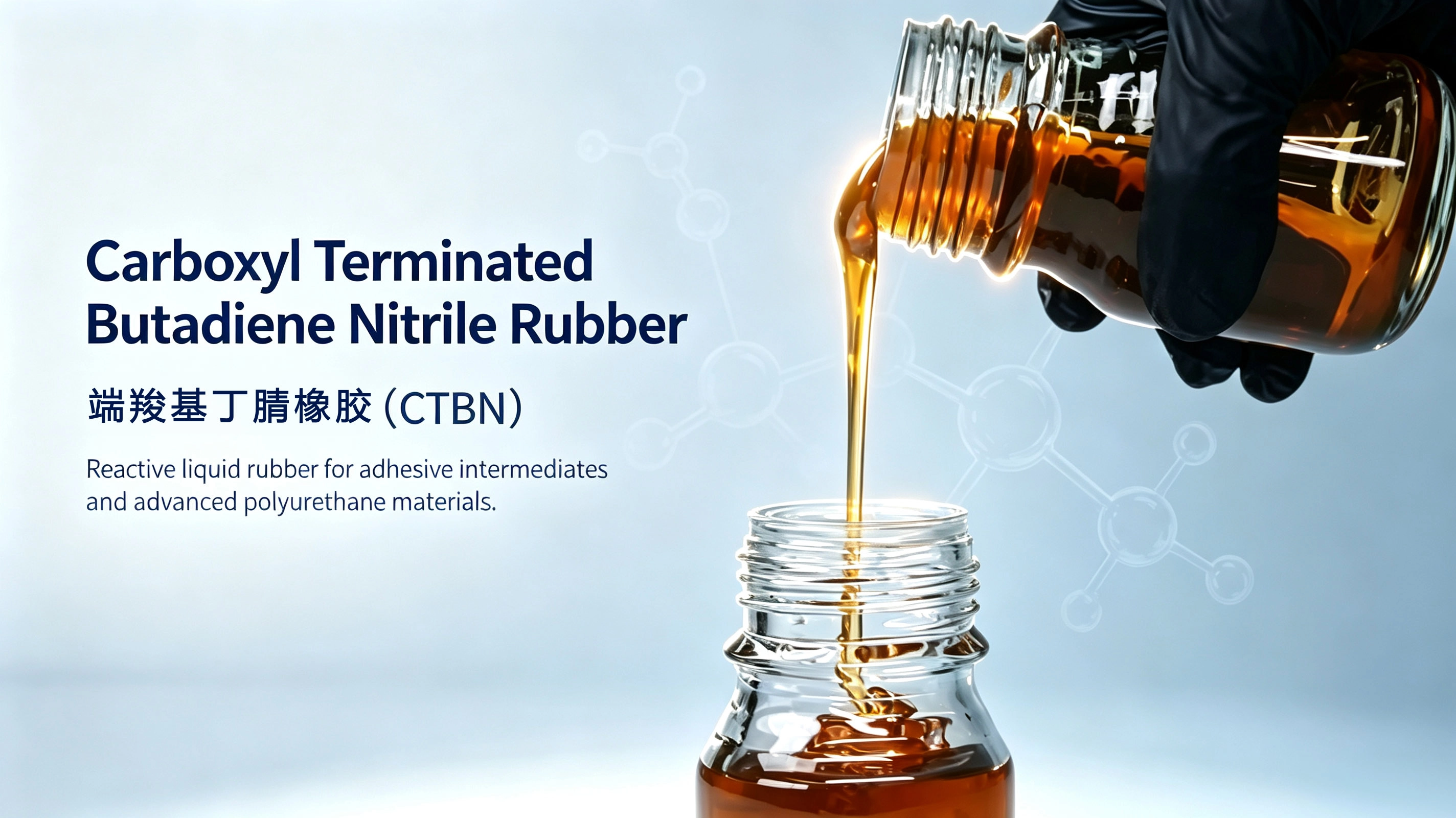
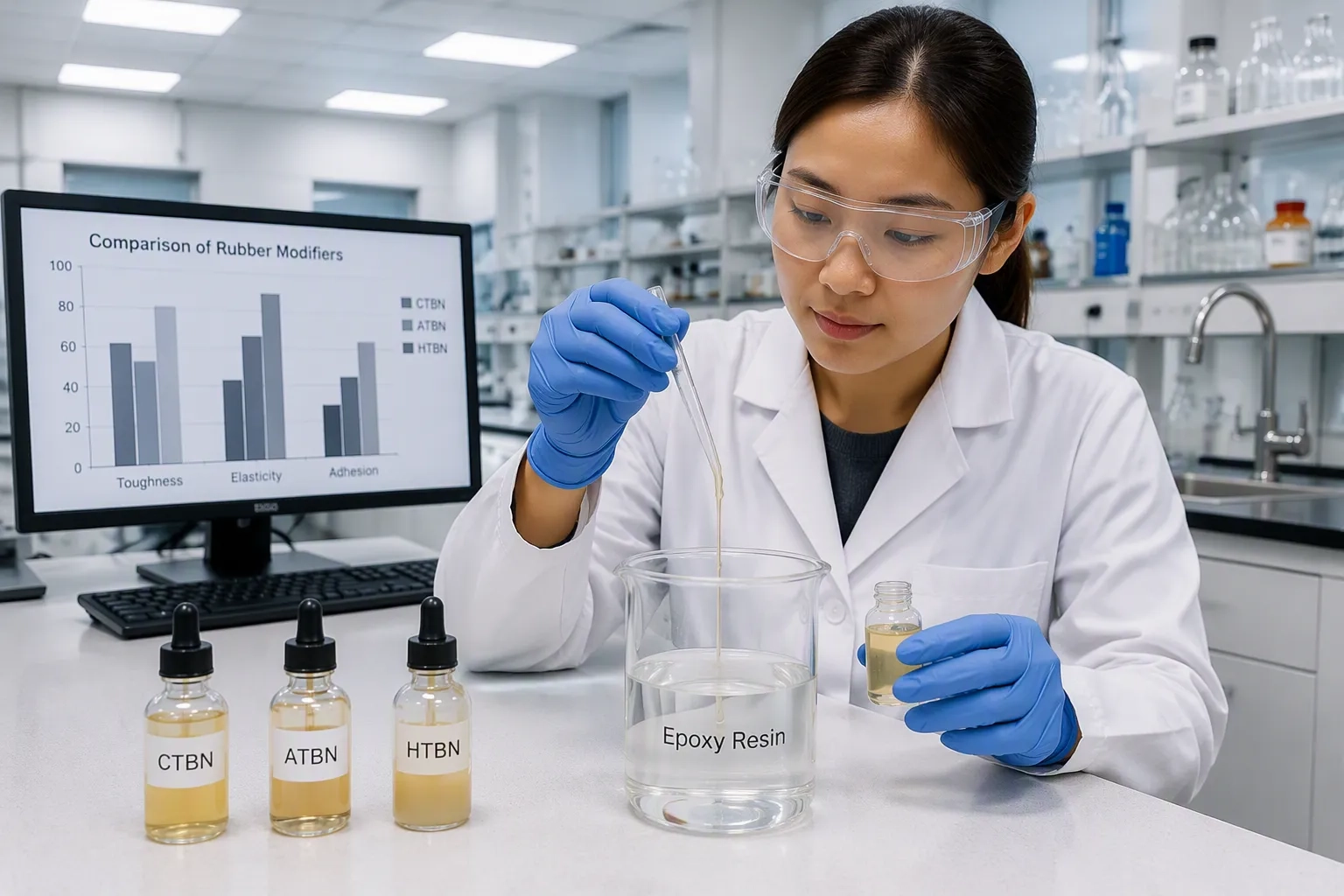
CTBN is widely used as a reactive liquid rubber for improving the toughness of epoxy systems, but not all CTBN grades behave the same way. One of the most important differences is acrylonitrile content, which changes the polarity of the rubber phase and, in turn, influences its interaction with the epoxy resin.
That interaction matters because CTBN does not toughen epoxy simply by making the cured material softer. Its effectiveness depends heavily on what happens during mixing and curing: how the rubber dissolves or disperses, when phase separation occurs, what morphology develops, and how the resulting rubber domains interact with a propagating crack.
For formulators, the practical question is therefore not whether a higher or lower acrylonitrile level is inherently better. The more useful question is how the CTBN composition fits the epoxy resin, curing agent, rubber loading, viscosity target, and required mechanical performance.
How Acrylonitrile Changes the Molecular Behavior of CTBN
More Acrylonitrile Increases Rubber Polarity
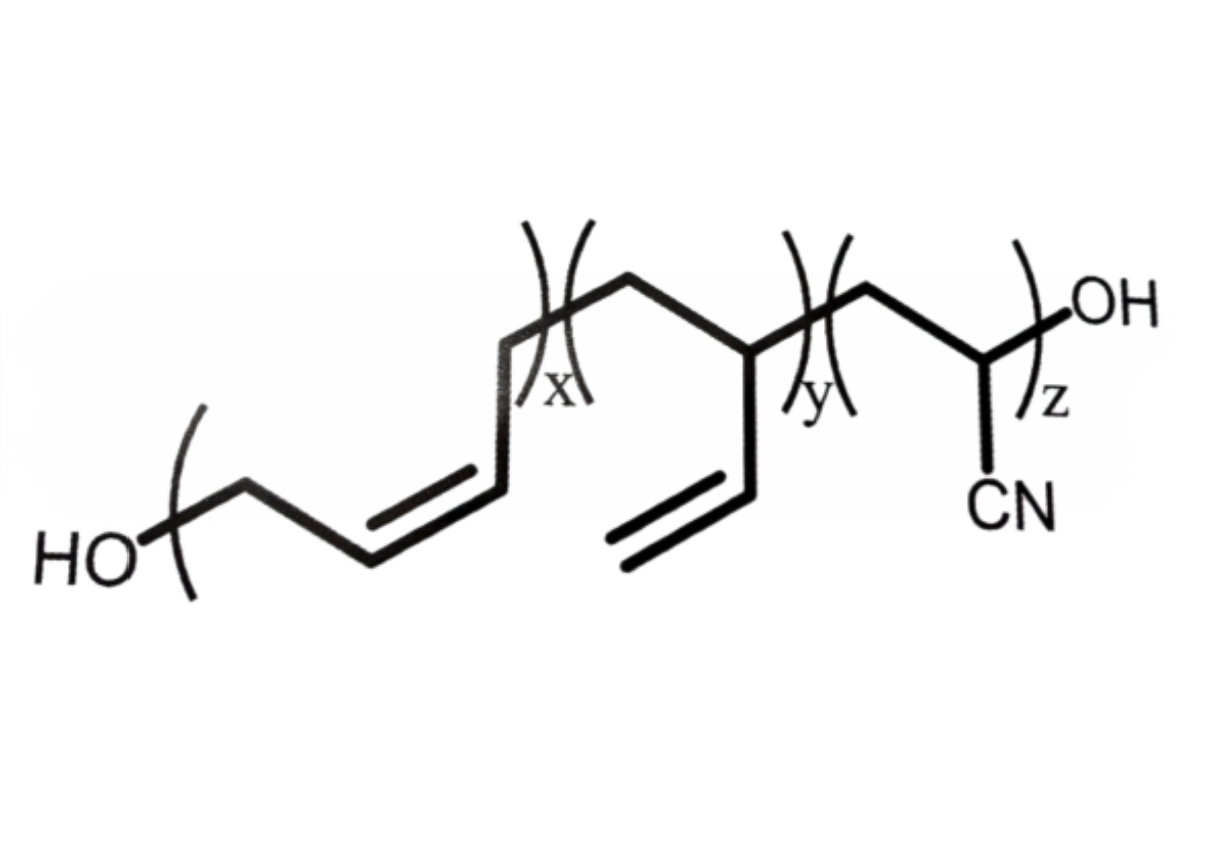
CTBN is a copolymer containing butadiene and acrylonitrile segments, with carboxyl termination providing reactive functionality. Increasing the proportion of acrylonitrile introduces more polar groups into the polymer structure.
This changes how the liquid rubber interacts with the surrounding epoxy resin. Compared with a lower-polarity polybutadiene-rich structure, a higher-acrylonitrile CTBN generally has stronger interactions with relatively polar components of an epoxy formulation.
The difference may affect:
· CTBN epoxy compatibility during initial formulation
· Interaction between rubber and epoxy-rich phases
· The onset and extent of phase separation during cure
· Final rubber-domain morphology
· Formulation viscosity and processing behavior
The important point is that acrylonitrile content is not an isolated performance number. It changes the chemical environment around the polymer chains, and that change can propagate through the entire curing process.
Acrylonitrile Content Also Affects Processing Behavior
The molecular interaction created by acrylonitrile can influence how CTBN behaves in an uncured resin. However, viscosity should not be attributed to acrylonitrile content alone. Molecular weight, molecular-weight distribution, temperature, rubber concentration, and the epoxy formulation itself can all have significant effects.
This distinction matters in production. A CTBN grade that performs well in a small laboratory batch may become difficult to process when the same formulation is scaled up, particularly when high filler loading or relatively low processing temperatures are involved.
For industrial formulations, CTBN viscosity, dispersion behavior, mixing temperature, and the time required to reach a uniform blend should therefore be evaluated alongside mechanical properties.
The Relationship Between Acrylonitrile Content and Epoxy Compatibility
Why Lower AN CTBN Can Behave Differently in Epoxy
A CTBN with a lower acrylonitrile level generally has a less polar rubber phase. In some epoxy formulations, this can reduce the interaction between the rubber and resin before curing and favor stronger segregation of the rubber-rich phase as the epoxy network develops.
That behavior is not necessarily undesirable. Effective toughening often requires a controlled rubber-rich dispersed phase rather than complete molecular-level compatibility after cure.
The challenge is finding the right degree of interaction. If the rubber separates too early or forms excessively large domains, the resulting morphology may reduce the efficiency of stress transfer and create unfavorable stress concentrations. If the rubber remains too compatible throughout cure, the formulation may not develop the discrete rubber domains needed for efficient energy dissipation.
Why Higher AN CTBN Can Increase Resin Interaction
Increasing acrylonitrile content generally raises the polarity of the CTBN phase and can strengthen its interaction with the epoxy-rich environment. This can change both the initial compatibility and the kinetics of phase separation during curing.
However, higher AN content does not automatically mean better epoxy compatibility or better toughening. A formulation needs an appropriate final morphology, not simply the strongest possible interaction between rubber and resin.
The curing reaction continuously changes the epoxy phase. As molecular weight increases and the network develops, the thermodynamic balance between the epoxy and rubber phases also changes. A CTBN that appears highly compatible before cure may still undergo significant phase separation later in the cure cycle.
For this reason, compatibility should be evaluated at several stages rather than judged from the appearance of the uncured mixture alone.
How Acrylonitrile Content Changes Phase Separation and Toughening Morphology
Initial Mixing Is Not the Same as Final Morphology
The behavior of CTBN during epoxy curing can be viewed as a moving balance between dissolution, interaction, and phase separation.
Initially, the liquid rubber may be substantially dissolved or finely distributed in the uncured epoxy. As curing proceeds, the epoxy molecules become larger and eventually form a three-dimensional network. The changing composition and molecular structure of the resin phase can reduce its ability to accommodate the rubber.
At that point, CTBN-rich domains begin to develop.
The final morphology depends on several variables at once, including:
· Acrylonitrile content and resulting polarity
· CTBN molecular weight and molecular-weight distribution
· Epoxy resin chemistry
· Curing-agent chemistry
· CTBN loading
· Cure temperature and cure schedule
· Mixing history and shear conditions
This is why two CTBN products with similar carboxyl functionality can produce noticeably different epoxy morphology.
Why Rubber Particle Size Matters
Once phase separation occurs, the size and distribution of the rubber-rich domains become critical to toughening efficiency.
When an epoxy matrix containing dispersed CTBN is subjected to a crack, rubber domains can contribute to energy dissipation through mechanisms such as rubber cavitation, local plastic deformation, and crack deflection. The effectiveness of these mechanisms depends strongly on particle morphology and the quality of the rubber–matrix interface.
Very large domains may act as defects rather than efficient toughening sites. On the other hand, an extremely fine or poorly developed rubber phase may not generate the deformation mechanisms required for substantial energy absorption.
The objective is therefore not simply “more phase separation.” The objective is controlled phase morphology that promotes crack-energy dissipation without sacrificing too much stiffness, strength, or thermal performance.
Does Higher Acrylonitrile Content Always Improve CTBN Toughening?
No. The relationship is not linear.
Higher acrylonitrile content can increase polarity and resin interaction, but the final toughening response depends on how that interaction translates into cured morphology. The same CTBN grade can also behave differently when transferred from one epoxy formulation to another.
CTBN characteristic | Lower acrylonitrile level | Higher acrylonitrile level |
Rubber polarity | Generally lower | Generally higher |
Interaction with polar resin components | Generally weaker | Generally stronger |
Phase-separation behavior | Can favor stronger rubber-rich segregation in some systems | Can alter or delay phase separation depending on formulation |
Initial resin interaction | Lower in many epoxy systems | Higher in many epoxy systems |
Final toughening efficiency | Highly dependent on morphology | Highly dependent on morphology |
Processing behavior | Depends on molecular weight and formulation | Depends on molecular weight and formulation |
The table should be read as a general formulation tendency rather than a universal rule. Acrylonitrile content cannot be used by itself to predict fracture toughness, impact resistance, or final particle size.
For a meaningful comparison, CTBN grades should be tested under the same resin, loading, mixing, curing, and specimen-preparation conditions.
Acrylonitrile Content and the Balance Between Toughness and Tg
Epoxy toughening always involves a balance between damage tolerance and the properties provided by the rigid crosslinked network.
CTBN introduces a rubber phase into that network. Increasing CTBN loading can improve flexibility and fracture resistance, but it may also reduce modulus or alter the glass transition temperature. Acrylonitrile content can influence this balance indirectly by changing rubber–resin interaction and the morphology of the cured material.
Toughness Is Not the Only Target
A formulation designed for a structural adhesive may prioritize fracture toughness and bond durability, while an encapsulation or composite system may place greater emphasis on modulus, Tg, dimensional stability, or processing viscosity.
Relevant performance indicators can include:
· Fracture toughness and crack-growth resistance
· Impact and damage tolerance
· Tensile strength and elongation
· Modulus
· Glass transition temperature
· Adhesion to the intended substrate
· Thermal and environmental durability
A CTBN grade should therefore be judged against the complete performance profile rather than a single toughness value.
Why Tg Can Change After CTBN Modification
The effect of CTBN on Tg is influenced by rubber loading, phase morphology, cure conversion, and the degree to which the rubber interacts with the developing epoxy network.
A stronger interaction between CTBN and the epoxy phase does not necessarily produce a higher Tg. Likewise, a lower-AN rubber does not automatically result in an unacceptable Tg reduction.
The actual result depends on how much CTBN enters the continuous epoxy phase, how the rubber domains develop, and how the curing reaction builds the final network.
This is another reason why CTBN epoxy performance should be evaluated as a formulation-level property rather than predicted from acrylonitrile content alone.
How Acrylonitrile Content Affects CTBN Viscosity and Processing
Viscosity becomes increasingly important when a CTBN-modified epoxy moves from laboratory development to commercial production.
A high-viscosity liquid rubber can affect resin blending, pumping, metering, degassing, filler incorporation, and application. In adhesive formulations, excessive viscosity may also limit the usable filler content or application method.
Acrylonitrile content can contribute to changes in polymer–polymer and polymer–resin interactions, but it should always be considered alongside molecular weight.
For example, two CTBN grades with similar acrylonitrile levels can have very different handling characteristics if their molecular weights or molecular-weight distributions differ substantially.
For production engineers, the useful comparison is therefore not simply:
“Which CTBN has the right AN content?”
It is:
“Which combination of AN content, molecular weight, functionality, viscosity, and loading gives the required cured morphology while remaining processable?”
Choosing CTBN Acrylonitrile Content for Different Epoxy Applications
There is no single AN level that suits every epoxy application. The appropriate range depends on what the formulation needs the rubber to accomplish.
Structural Epoxy Adhesives
Structural adhesives typically require a combination of toughness, adhesion, strength retention, and controlled processing viscosity. In these systems, CTBN selection should consider how acrylonitrile content affects the rubber–epoxy interaction and final dispersed-phase morphology.
The curing system is equally important because the same CTBN can produce a different morphology with a different epoxy resin or curing agent.
Composite and Encapsulation Systems
Composite and encapsulation formulations often impose additional processing constraints. Resin flow, filler loading, degassing, thermal performance, and dimensional stability can be as important as impact resistance.
A CTBN with suitable toughness data may still be unsuitable if its viscosity prevents the required filler level or creates poor wetting and dispersion.
Toughened Epoxy Coatings and Industrial Formulations
Coatings may require flexibility, adhesion, impact resistance, and resistance to cracking while maintaining acceptable application viscosity. Here, the CTBN grade needs to fit both the uncured processing window and the cured film properties.
The best choice is usually established through comparative formulation trials rather than AN content alone.
Formulation priority | CTBN selection focus |
High fracture resistance | Final rubber morphology and rubber–epoxy interface |
Stronger resin interaction | Acrylonitrile level together with epoxy chemistry |
Lower formulation viscosity | Molecular weight, temperature, loading, and resin viscosity |
High Tg retention | CTBN loading, phase morphology, and cure chemistry |
Stable production | Specification control and batch-to-batch consistency |
Consistent mechanical performance | AN content, functionality, molecular weight, and morphology |
How to Evaluate CTBN Before Choosing an Acrylonitrile Level
Acrylonitrile content should be one part of the technical specification, not the entire basis for grade selection.
Before committing to a CTBN grade, formulators and purchasing teams should review:
· Acrylonitrile content and its acceptable production tolerance
· Carboxyl functionality or acid value
· Molecular weight and molecular-weight distribution
· Viscosity at a defined temperature
· Appearance and storage stability
· Moisture and volatile content
· Batch-to-batch consistency
· Recommended processing conditions
The most useful supplier comparison combines specification data with application testing. If the end use is a high-performance epoxy adhesive, for example, a useful evaluation should include the cured formulation's fracture behavior, tensile properties, Tg, morphology, and viscosity—not just the CTBN's certificate of analysis.
Consistent raw-material quality is also important during scale-up. Variations in molecular weight, functionality, or acrylonitrile level can shift formulation viscosity and cured morphology even when the nominal CTBN grade remains unchanged. For this reason, a supplier's material quality control and batch consistency should be considered part of the selection process.
A Practical CTBN Selection Strategy for Epoxy Formulators
A more reliable approach is to start with the finished epoxy requirements and work backward.
1. Define the required mechanical performance. Set targets for fracture toughness, impact resistance, tensile strength, modulus, and Tg rather than optimizing “toughness” as a single property.
2. Define the processing window. Establish acceptable viscosity, mixing temperature, filler loading, degassing conditions, and application method.
3. Characterize the epoxy system. Resin functionality, curing agent, stoichiometry, cure temperature, and cure schedule all affect CTBN phase behavior.
4. Compare CTBN grades at controlled loading. Keep resin, CTBN concentration, mixing conditions, and cure schedule consistent.
5. Examine cured morphology. Mechanical data alone may not explain why one CTBN grade performs better than another.
6. Confirm production consistency. Repeat testing across batches before moving from laboratory formulation to commercial production.
For buyers evaluating a CTBN supplier, this approach also provides a better basis for technical discussions. Instead of asking only for acrylonitrile content and price, it is more useful to request the full specification package and application data needed to determine whether the material will remain consistent under actual processing conditions.
Acrylonitrile Content Is a Formulation Variable, Not a Quality Ranking
Acrylonitrile content is one of the key variables that distinguishes CTBN grades, but it should not be treated as a simple ranking from low performance to high performance.
Changing the AN level changes the polarity of the rubber phase and can alter resin interaction, phase-separation behavior, viscosity, and cured morphology. Those changes ultimately influence how the rubber phase dissipates energy when the epoxy is damaged.
The practical selection chain is therefore:
Acrylonitrile content → polarity → resin interaction → phase behavior → rubber morphology → crack-energy dissipation → final epoxy performance
Molecular weight, carboxyl functionality, CTBN loading, epoxy chemistry, curing-agent chemistry, and cure conditions remain equally important.
For formulators, the right CTBN grade for epoxy toughening is the one that produces the required morphology and performance within a workable processing window. For purchasing teams, the right material is one that delivers those properties consistently from batch to batch. Further New Material provides CTBN for applications where controlled liquid-rubber properties and formulation consistency are important.

 English
 English
  Spanish
  Russian
  Arabic
  French
  German
  Portuguese
  Turkish
  Dutch
Dutch  Polish
  Korean
  Vietnamese
  Indonesian
 29. Jul, 2026