Why Standard HTPB Can Be Difficult to Incorporate Into Epoxy Systems
HTPB is attractive as a liquid rubber because its low-temperature flexibility, low viscosity relative to solid elastomers, and reactive hydroxyl groups make it useful in polyurethane chemistry. The situation is different when HTPB is introduced into an epoxy resin system.
The main issue is chemical compatibility. Conventional HTPB has a largely hydrocarbon-based backbone and is relatively nonpolar, while epoxy resins contain polar functional groups and form increasingly polar, highly crosslinked structures during cure. As a result, simply mixing HTPB into an epoxy resin does not guarantee good compatibility throughout processing and curing.
The difference can become visible in several ways. The blend may become difficult to keep homogeneous, rubber-rich domains may become poorly controlled during cure, or the final interface between the rubber and epoxy matrix may not provide the expected balance of toughness and mechanical strength.
This is where epoxy modified HTPB becomes interesting. Rather than changing only the amount of liquid rubber in the formulation, epoxidation changes the chemistry of the polybutadiene itself.
What Epoxidation Actually Changes in the HTPB Structure
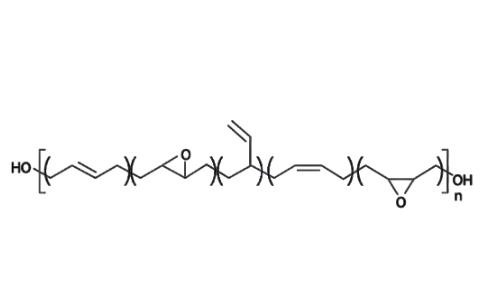
Adding Epoxy Groups to the Polybutadiene Backbone
HTPB contains carbon-carbon double bonds along its polybutadiene structure. During epoxidation, some of these unsaturated sites are converted into epoxide groups.
That chemical modification changes the character of the polymer without removing its underlying polybutadiene backbone. The result is a liquid rubber with a different balance of hydrocarbon and oxygen-containing functionality.
The change is important because epoxide groups are more polar than the original hydrocarbon structure. They can interact more readily with components of an epoxy formulation, potentially improving the compatibility of the liquid rubber with the surrounding resin phase.
The degree of modification matters. A product with a relatively low level of epoxidation and one with a substantially higher level should not be expected to behave identically, even if both are described as epoxidized HTPB.
Further's epoxy modified HTPB is part of its liquid polybutadiene portfolio for applications where chemical modification is used to change the behavior of the base polymer.
Epoxidation Changes More Than Polarity
It is tempting to describe epoxidation as a simple way to make HTPB more compatible with epoxy resin. That explanation is incomplete.
Introducing epoxide functionality can affect several properties at the same time:
· Polarity and intermolecular interaction
· Potential reactivity with the curing system
· Viscosity and flow behavior
· Phase behavior during epoxy curing
· Interfacial interaction between rubber and resin
These effects are interconnected. Improving polarity may help the rubber interact with the epoxy resin, but additional functionality can also change the way the rubber participates in the curing process.
For formulation work, the useful question is therefore not simply how much epoxidation a product has. It is how that level of modification fits the resin, curing agent, rubber loading and processing conditions.
Why Epoxy Modified HTPB Can Be More Compatible With Epoxy Resin
Polarity Matching
The basic compatibility problem between conventional HTPB and epoxy resin can be viewed as a difference in molecular character.
The polybutadiene portion of HTPB is relatively nonpolar. Epoxy resin systems generally contain more polar structures. Introducing epoxide groups shifts the liquid rubber toward a more polar character, which can improve its interaction with the epoxy phase.
This does not mean that an epoxidized polymer will be completely miscible with every epoxy resin. Compatibility is not a binary property. It can change with resin chemistry, molecular weight, concentration and temperature.
A better description is that epoxidation can reduce the polarity mismatch between liquid polybutadiene and an epoxy formulation.
Interfacial Interaction
Compatibility also matters after the formulation begins to cure.
If the rubber and epoxy phases interact more effectively, the interface between them can become more favorable for stress transfer. This can influence how the material responds when a crack or deformation reaches a rubber-rich region.
The benefit is therefore not limited to keeping the liquid formulation visually uniform. The more important question is what type of morphology develops after curing and whether the resulting rubber-rich domains remain well integrated with the epoxy matrix.
Compatibility During Curing
Initial mixing and final morphology are not the same thing.
An epoxy formulation can appear homogeneous before cure and still develop significant phase separation as the epoxy molecular weight and crosslink density increase. Conversely, controlled phase separation can be useful when the resulting morphology creates effective toughening without excessively weakening the matrix.
For this reason, HTPB epoxy compatibility should be evaluated throughout the curing process, not only by looking at the uncured blend.
Epoxidation Level Creates a Trade Off Between Compatibility and Reactivity
The degree of epoxidation is one of the most important variables when selecting an epoxy modified liquid polybutadiene.
A higher level of epoxidation generally introduces more polar functionality, but that does not mean the highest possible level will always produce the best formulation.
As modification increases, the material can have a greater influence on the epoxy system's chemistry and physical behavior. Viscosity may change, the response to the curing agent may change, and the balance between rubber-rich and resin-rich phases can shift.
Property | Lower Degree of Epoxidation | Higher Degree of Epoxidation |
Polymer polarity | Lower | Higher |
Interaction with epoxy resin | More limited in some systems | Potentially stronger |
Epoxide functionality | Lower | Higher |
Influence on curing | Generally smaller | Potentially greater |
Processing impact | Often closer to base HTPB | May require more formulation adjustment |
Compatibility response | Highly formulation-dependent | More strongly influenced by resin and cure chemistry |
The right target is therefore not maximum epoxidation. It is the degree of modification that provides the required compatibility without creating unwanted processing or curing behavior.
That balance is particularly important in formulations where the liquid rubber must remain flexible while the epoxy matrix retains sufficient modulus, thermal performance and dimensional stability.
How Epoxy Modified HTPB Behaves During Epoxy Curing
Before Cure
Before curing begins, the main concerns are mixing, viscosity and dispersion.
The modified liquid rubber needs to distribute through the epoxy resin without excessive agglomeration or local concentration differences. Epoxidation can improve interaction with the resin phase, but the result still depends on molecular weight, rubber concentration, temperature and the specific epoxy resin being used.
A formulation that requires prolonged mixing or elevated temperature should be evaluated under realistic production conditions rather than relying only on room-temperature laboratory observations.
During Cure
The system becomes more complicated as curing proceeds.
Epoxy molecules react with the curing agent, molecular weight increases and the network begins to develop. The compatibility between the liquid rubber and the increasingly crosslinked epoxy phase can change during this process.
At the same time, any reactive groups on the modified rubber may influence the local reaction environment.
This is why the phase morphology of cured epoxy can be quite different from what is observed in the uncured formulation. The timing of phase separation, the size of rubber-rich domains and the quality of the interface all contribute to the final mechanical response.
After Cure
Once the epoxy has fully cured, the important question becomes how the resulting morphology affects performance.
A useful rubber phase can provide additional mechanisms for dissipating mechanical energy, but excessive rubber content or poorly controlled morphology can reduce modulus, Tg or strength.
The goal is not simply to maximize rubber dispersion. The goal is to obtain a stable and useful microstructure that improves the property the formulation actually needs.
Molecular Weight Still Matters After Epoxidation
Chemical modification does not make molecular weight irrelevant.
Two epoxidized polybutadiene grades can have similar epoxy functionality but behave differently because their molecular weights and molecular-weight distributions are different. Higher molecular weight generally affects viscosity and chain mobility, which in turn influence processing and morphology.
For an epoxy formulation, molecular weight can affect:
· Blend viscosity and mixing requirements
· Rubber-domain formation during cure
· Chain mobility and flexibility
· Processing temperature
· Final mechanical behavior
This is why comparing only epoxy content or degree of epoxidation can lead to misleading conclusions.
The base material also matters. Conventional HTPB contains its own molecular-weight and hydroxyl-functionality characteristics, and those parameters provide useful context when evaluating what has changed after epoxidation.
Compatibility Depends on the Epoxy Formulation Too
An epoxidized liquid rubber cannot be evaluated independently from the epoxy system in which it will be used.
Different epoxy resins have different molecular structures and viscosities. Curing agents introduce another variable because they determine how quickly the network develops and which functional groups participate in the reaction.
Rubber loading also has a major effect. At low concentrations, the modified polymer may influence flexibility and local stress distribution without dominating the matrix. At higher concentrations, viscosity, morphology, Tg and modulus can change substantially.
Three formulation variables deserve particular attention:
1. Epoxy resin chemistry — the resin determines the polarity and reactive environment surrounding the modified rubber.
2. Curing chemistry — curing rate and reaction pathway influence when and how the rubber phase develops.
3. Rubber concentration — increasing the loading can improve flexibility but may also reduce modulus and thermal performance.
The useful loading level is therefore application-specific rather than a fixed number that applies to every epoxy system.
How to Evaluate Epoxy Modified HTPB Before Formulation Trials
A technical data sheet should provide enough information to establish whether a grade deserves laboratory evaluation. Procurement and R&D teams should look beyond a single viscosity or epoxy-content value.
Specification | Why It Matters |
Epoxy content or epoxy equivalent | Indicates the available epoxy functionality |
Hydroxyl value | Shows the remaining hydroxyl functionality and its potential formulation impact |
Degree of epoxidation | Helps assess changes in polarity and reactivity |
Molecular weight | Influences viscosity, chain mobility and morphology |
Viscosity | Determines mixing, metering and processing requirements |
Molecular-weight distribution | Can affect consistency and phase behavior |
Moisture | Can interfere with some epoxy curing systems |
Appearance and batch consistency | Important for production control |
For qualification, it is useful to compare the candidate material against the existing liquid rubber under the same formulation conditions.
The comparison should cover more than uncured viscosity. At minimum, evaluate dispersion, cure behavior, Tg, tensile properties, elongation, modulus and fracture or impact performance according to the intended application.
This approach helps separate a genuine compatibility improvement from a simple change in formulation viscosity.
When Epoxy Modified HTPB Makes More Sense Than Conventional HTPB
Epoxidized HTPB becomes more attractive when compatibility between a conventional polybutadiene-based liquid rubber and an epoxy formulation is limiting the formulation design.
It can be worth investigating when:
· The base HTPB shows insufficient interaction with the epoxy resin
· A reactive liquid rubber is preferred over a purely physical flexibilizer
· The formulation needs a better balance between rubber incorporation and epoxy-matrix integrity
· Processing requires a liquid modifier that can be incorporated without introducing a separate solid rubber phase
But modification should not be treated as an automatic upgrade.
If conventional HTPB already provides the required processing behavior, compatibility and cured properties, moving to a more highly functionalized grade may introduce unnecessary changes to the formulation.
The right material is the one that fits the chemistry and performance window of the finished product.
The Right Epoxy Modified HTPB Depends on the Whole Formulation
Epoxidation changes HTPB at the molecular level by introducing epoxide functionality into the polybutadiene structure. That change can increase polarity and alter the way liquid rubber interacts with an epoxy resin, but the result depends on much more than the presence of epoxy groups.
The most useful way to evaluate an epoxidized polybutadiene is to follow the entire chain:
HTPB structure → degree of epoxidation → polarity and functionality → resin interaction → curing behavior → phase morphology → final properties
For formulators, that means looking at epoxy functionality alongside molecular weight, viscosity, hydroxyl value, rubber loading and curing chemistry.
For procurement teams, it means asking suppliers for enough technical information to compare grades on a reactive and formulation basis rather than choosing by viscosity or price alone.
A well-selected epoxy modified HTPB should solve a specific formulation problem. Its value comes from how predictably it works inside the complete epoxy system, not simply from having a higher level of chemical modification.

 English
 English
  Spanish
  Russian
  Arabic
  French
  German
  Portuguese
  Turkish
  Dutch
Dutch  Polish
  Korean
  Vietnamese
  Indonesian
 07. Aug, 2026