Why Dynamic Performance Matters in Polyurethane Elastomers
Polyurethane elastomers used in industrial equipment rarely operate under static conditions. Solid tires roll under continuous loads, conveyor rollers undergo repeated compression, and mechanical seals experience thousands of deformation cycles during service. In these applications, a material must do more than withstand a single tensile or compression test. It must retain its mechanical properties while absorbing and releasing energy repeatedly.
One of the main challenges is heat build-up during cyclic deformation. Each loading and unloading cycle causes some mechanical energy to dissipate as heat. If this loss becomes excessive, the material temperature can rise, accelerating physical aging, softening, permanent deformation, and eventually fatigue damage.
Several properties therefore need to be considered together:
Low hysteresis: Less mechanical energy is lost during repeated loading and unloading.
High rebound resilience: The elastomer recovers effectively after deformation.
Fatigue resistance: Repeated stress does not lead to premature crack initiation or propagation.
Abrasion resistance: The material maintains its surface and dimensions under friction and contact.
Thermal stability: Mechanical performance remains consistent as operating temperature changes.
The choice of diisocyanate influences how the polyurethane hard segments develop and how they interact with the flexible soft segments. Trans-1,4-cyclohexane diisocyanate (Trans-CHDI) is particularly relevant to demanding elastomer applications because of its compact, symmetrical molecular structure.
Rather than treating Trans-CHDI simply as another curing component, formulators should consider how its molecular architecture affects the organization of the polyurethane structure and, ultimately, its response to repeated mechanical stress.
How Trans-CHDI Molecular Structure Influences Polyurethane Hard Segments
The Significance of the Trans-1,4 Cyclohexane Structure
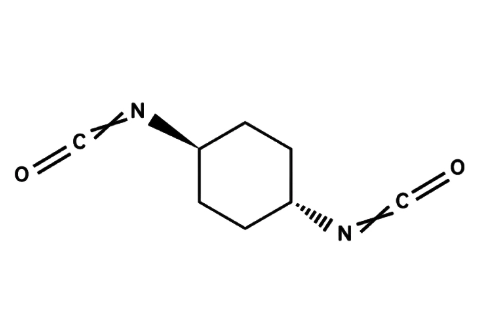
Trans-CHDI, also known as trans-1,4-cyclohexane diisocyanate (CAS No. 7517-76-2), contains two isocyanate groups attached to opposite positions of a cyclohexane ring in a trans configuration.
This arrangement gives the molecule a relatively symmetrical structure. Compared with less symmetrical molecular arrangements, the trans-1,4 configuration can favor more regular packing when the diisocyanate reacts with polyols and forms polyurethane chains.
During polyurethane synthesis, the two NCO groups react with hydroxyl groups to form urethane linkages. These linkages contribute to the hard segments of the polymer, while the polyol-derived portions generally form the more flexible soft segments.
The resulting properties depend on more than the diisocyanate alone. Nevertheless, the geometry of the isocyanate component can influence how hard segments associate and how the different segments organize within the polymer.
For formulators, this structural consideration is important when designing elastomers that need both mechanical support and repeated deformation capability.
Why Hard-Segment Organization Matters
Polyurethane elastomers typically contain hard and soft segments with different chemical structures and physical characteristics.
Soft segments provide chain mobility and flexibility. Hard segments contribute to strength, modulus, physical association, and resistance to deformation. Their distribution and interaction determine much of the material's viscoelastic behavior.
When hard segments form sufficiently organized domains, they can act as physical junctions within the polymer. These domains help the material withstand applied stress while allowing the flexible portions of the chains to deform.
The balance is important. Excessive hard-segment association may increase stiffness but restrict chain mobility. Insufficient association, on the other hand, may reduce the material's ability to retain its shape under load.
Trans-CHDI offers a molecular structure that can promote more orderly hard-segment organization. Its effect on phase separation and mechanical behavior, however, depends on the polyol chemistry, chain extender, hard-segment concentration, and processing conditions.
For a specific formulation, the relevant question is not simply whether the polymer has a more ordered structure. It is whether that structure provides the right balance of stiffness, resilience, and energy dissipation for the intended service conditions.
How Trans-CHDI Influences Dynamic Mechanical Behavior
Hysteresis and Heat Build-Up Under Repeated Loading
When a polyurethane elastomer is compressed and then allowed to recover, the unloading path usually differs from the loading path. The enclosed area of the stress-strain loop represents the energy dissipated during that cycle.
This behavior is known as mechanical hysteresis.
Some energy dissipation is unavoidable in viscoelastic materials. However, when an elastomer undergoes frequent deformation, excessive hysteresis can generate considerable internal heat.
The relationship becomes particularly important in solid tires, industrial rollers, and other components that experience continuous cyclic loading. A material that performs well in a room-temperature tensile test may still develop excessive heat during prolonged operation.
Trans-CHDI can contribute to lower hysteresis in appropriately designed polyurethane systems. Its symmetrical structure supports the development of organized hard-segment domains, which can influence the way stress is distributed and dissipated throughout the polymer.
The actual result must be confirmed through dynamic testing rather than inferred from molecular structure alone.
Several measurements are useful:
Storage modulus (E' or G'): Represents the elastic component of the material's response and its ability to store deformation energy.
Loss modulus (E'' or G''): Describes the viscous component associated with energy dissipation.
Loss factor (tan δ): The ratio of loss modulus to storage modulus, commonly used to evaluate viscoelastic damping.
A lower tan δ under relevant operating conditions may indicate reduced relative energy dissipation. However, tan δ should not be interpreted in isolation. Temperature, frequency, strain amplitude, and the absolute modulus values all affect how a material behaves in service.
For dynamic components, measuring temperature rise under representative cyclic loading is also valuable. It provides a more direct indication of heat accumulation than relying on a single room-temperature mechanical property.
Elastic Recovery After Repeated Deformation
Resilience is another important consideration in polyurethane elastomers subjected to repeated compression or impact.
After an applied load is removed, the material should recover its original shape as effectively as possible. Poor recovery can lead to compression set, permanent deformation, and gradual loss of dimensional accuracy.
The hard-segment structure influences this behavior by providing physical support within the polymer network. Meanwhile, the soft segments must retain enough mobility to allow the material to recover after deformation.
Trans-CHDI can help formulators develop a favorable balance between structural support and elastic response. This is particularly relevant when the elastomer must maintain its shape over repeated loading cycles without becoming excessively rigid.
It is important to distinguish rebound resilience from fatigue resistance. A material may recover well after an individual impact but still develop cracks after prolonged cyclic stress. Both properties need to be evaluated for components exposed to demanding operating conditions.
Fatigue Resistance and Crack Development
Repeated mechanical loading can gradually damage polyurethane elastomers, even when the applied stress remains below the material's initial tensile strength.
Local stress concentrations may develop around defects, inclusions, poorly dispersed hard domains, or regions with inconsistent crosslink density. Over time, these areas can become sites for crack initiation.
Once a crack forms, continued loading may cause it to grow until the component loses its mechanical integrity.
A well-designed polyurethane structure can help distribute applied stress more effectively and maintain a balance between stiffness and flexibility. The molecular structure introduced by Trans-CHDI is one factor that can contribute to this balance.
Nevertheless, fatigue life is a formulation-level property, not an inherent guarantee provided by a single raw material. Soft-segment chemistry, molecular weight, hard-segment content, cure quality, residual stresses, and operating temperature all influence crack development.
For components such as industrial wheels, rollers, and dynamic seals, fatigue testing under realistic loading conditions is therefore essential.
Formulation Factors That Determine Trans-CHDI Performance
Selecting Trans-CHDI is only one part of polyurethane formulation design. Its contribution depends on how it is combined with the other reactive components and how the polymer is processed.
The following variables deserve particular attention.
| Formulation variable | Influence on the polyurethane | What formulators should evaluate |
|---|
| Polyol type and molecular weight | Determines soft-segment flexibility, chain mobility, and low-temperature behavior | Glass transition temperature, flexibility, dynamic modulus |
| NCO/OH ratio | Affects reaction stoichiometry, conversion, and network structure | Residual NCO, hardness, tensile properties |
| Chain extender | Influences hard-segment concentration and organization | Modulus, hardness, rebound, hysteresis |
| Trans-CHDI isomer composition | Affects molecular regularity and potentially hard-segment packing | Isomer composition and batch consistency |
| Cure temperature and time | Controls reaction completion and morphology development | Conversion, post-cure stability, property consistency |
| Moisture content | Can trigger unwanted reactions with isocyanate groups and generate carbon dioxide | Moisture control, void formation, mechanical consistency |
Balancing Hardness, Resilience, and Dynamic Durability
A common formulation mistake is to increase hard-segment content simply to obtain higher hardness or tensile strength.
Although additional hard segments can improve load-bearing capacity, excessive rigidity may restrict chain mobility and reduce flexibility. Depending on the formulation, it may also change the hysteresis behavior and increase the risk of localized stress concentrations.
A more useful approach is to define the operating requirements first and then adjust the formulation accordingly.
For example, an industrial roller operating continuously under compression may require a different balance of modulus, rebound, and heat build-up than a seal exposed to intermittent pressure cycles.
The following considerations can guide initial formulation work:
Select a polyol that provides the required flexibility, temperature range, and chemical resistance.
Adjust the NCO/OH ratio and chain extender level to achieve the desired network structure without unnecessarily increasing stiffness.
Optimize cure conditions to obtain consistent conversion and avoid defects that could become fatigue initiation points.
When HTPB is selected as the soft segment, its hydroxyl functionality and molecular characteristics also need to be considered alongside the isocyanate. The formulation implications are discussed in matching HTPB with the right isocyanate for polyurethane elastomer applications.
The final formulation should be judged by its complete mechanical response, not by hardness or tensile strength alone.
How to Evaluate Trans-CHDI-Based Polyurethane Elastomers
A meaningful evaluation should reproduce the conditions that the finished component will encounter. Conventional tensile and elongation tests remain useful for quality control, but they cannot fully predict performance under repeated deformation.
A combination of dynamic, thermal, and mechanical tests provides a more complete picture.
| Test method | Main measurement | Relevance to dynamic applications |
|---|
| Dynamic Mechanical Analysis (DMA) | Storage modulus, loss modulus, tan δ | Evaluates viscoelastic behavior across temperatures and frequencies |
| Rebound resilience test | Rebound percentage | Measures recovery after impact or deformation |
| Cyclic compression test | Temperature rise, compression set, stress response | Evaluates repeated compression and heat accumulation |
| Dynamic fatigue test | Cycles to failure, crack initiation or growth | Assesses resistance to repeated mechanical loading |
| Abrasion test | Volume loss or mass loss | Measures resistance to surface wear |
| Tensile test | Tensile strength and elongation at break | Establishes baseline mechanical properties |
Designing a Meaningful Comparison
When comparing Trans-CHDI-based polyurethane with another isocyanate system, test conditions must be carefully controlled.
If the samples differ substantially in hardness, polyol type, chain extender concentration, or curing conditions, the results may reflect those differences rather than the influence of the diisocyanate.
A more reliable comparison should:
Use the same polyol chemistry and, where practical, the same soft-segment molecular weight.
Maintain comparable hard-segment content and NCO/OH stoichiometry.
Apply consistent mixing, curing, and post-curing procedures.
Test samples at the same temperature, frequency, strain amplitude, and loading conditions.
Compare both initial properties and performance after repeated deformation.
For cyclic compression, recording specimen temperature over time can reveal differences in heat accumulation. DMA measurements at multiple temperatures and frequencies can help identify whether a formulation's advantages remain relevant across the intended operating range.
It is also useful to examine specimens after testing. Surface cracks, internal damage, permanent deformation, and changes in hardness may reveal failure mechanisms that are not apparent from the initial test results.
This type of evaluation gives formulators a practical basis for deciding whether Trans-CHDI offers a meaningful advantage in a particular application.
Industrial Applications Where Dynamic Performance Matters
The structural characteristics of Trans-CHDI-based polyurethane systems are relevant to applications where mechanical loading, temperature changes, and long-term durability must be considered together.
Solid Tires and Industrial Wheels
Solid polyurethane tires are exposed to repeated compression and rolling deformation. During operation, energy is dissipated within the material, contributing to internal temperature rise.
For these components, low hysteresis, rebound resilience, abrasion resistance, and fatigue performance are important selection criteria.
A Trans-CHDI-based formulation may be worth evaluating when the application requires a combination of load-bearing capacity and reduced heat accumulation. The final result depends on the tire geometry, hardness, polyol system, and operating load.
Conveyor Rollers, Belts, and Couplings
Industrial rollers and transmission components may operate for extended periods under continuous or intermittent mechanical stress.
Excessive heat build-up can accelerate material degradation, while poor fatigue resistance may result in cracking or surface damage. A suitable polyurethane formulation must maintain its mechanical response throughout repeated operating cycles.
In these applications, dynamic compression, abrasion, and fatigue testing should be considered alongside conventional mechanical specifications.
Dynamic Seals and Flexible Industrial Components
Seals and flexible components are frequently subjected to repeated compression, pressure fluctuations, and contact with oils or other process fluids.
In addition to elastic recovery, formulators need to consider hydrolysis resistance, chemical compatibility, compression set, and temperature stability.
Trans-CHDI can be considered in systems where these requirements overlap with demanding dynamic performance. However, fluid compatibility and long-term sealing behavior should always be confirmed using the actual media and service conditions.
When Should Formulators Consider Trans-CHDI?
Trans-CHDI is worth evaluating when a polyurethane elastomer must retain its mechanical performance under repeated deformation rather than simply meet a set of initial mechanical specifications.
It may be particularly relevant when the formulation targets:
Reduced hysteresis and controlled heat build-up during cyclic loading.
A balance of rebound resilience, mechanical support, and abrasion resistance.
Stable performance across a broad operating temperature range.
Resistance to environmental exposure, including moisture and outdoor conditions.
The choice is less straightforward when the primary requirement is the lowest possible raw-material cost, a specific processing window, or compatibility with an established production process. In such cases, Trans-CHDI should be compared with the incumbent isocyanate under equivalent formulation and processing conditions.
Its chemical identity, NCO content, isomer composition, and handling requirements should also be checked against the supplier's technical documentation before production trials.
For formulators assessing this chemistry, Trans-CHDI (trans-1,4-cyclohexane diisocyanate) is available as a specialty diisocyanate for high-performance polyurethane systems. It belongs to the broader range of specialty isocyanates for polyurethane and adhesive applications.
Dynamic performance in polyurethane elastomers is determined by the way molecular structure, segment organization, and formulation design work together under repeated mechanical stress.
Trans-CHDI brings a symmetrical trans-1,4-cyclohexane structure to polyurethane synthesis. This structure can support more organized hard-segment domains and influence the balance between stiffness, elastic recovery, and energy dissipation.
For applications such as solid tires, industrial rollers, conveyor components, and dynamic seals, these characteristics make Trans-CHDI a useful candidate for formulation evaluation.
The decisive evidence, however, comes from the finished elastomer. DMA, cyclic compression, rebound, abrasion, and fatigue testing under representative service conditions are needed to establish whether a Trans-CHDI-based system delivers the required performance.
For material developers, the most effective approach is to treat the diisocyanate as part of a complete formulation strategy—one that balances molecular structure with processing conditions and the demands of the actual application.

 English
 English
 Spanish
 Russian
 Arabic
 French
 German
 Portuguese
 Turkish
 Dutch
 Polish
 Korean
 Vietnamese
 Indonesian
 08. Jul, 2026