Epoxy Toughening Is a Network Design Problem
Epoxy resins are valued for their strength, stiffness, chemical resistance, and dimensional stability. The same highly crosslinked structure that gives cured epoxy these properties, however, can also make it vulnerable to brittle fracture. Adding liquid rubber is one way to address this weakness, but simply introducing a flexible polymer into an epoxy resin does not guarantee better performance. The important question is what happens to the polymer network during curing and what kind of structure remains after the reaction is complete.
This is where CTBN vs ATBN becomes a meaningful formulation question. Both are reactive liquid rubbers based on butadiene-acrylonitrile chemistry, yet their terminal functional groups are different. CTBN carries carboxyl functionality, while ATBN carries amine functionality. That difference affects how each material interacts with epoxy resin and curing agents, how the rubber phase develops during cure, and ultimately how the modified epoxy responds to impact, crack growth, and repeated mechanical loading.
For an engineer working on epoxy resin toughening, the objective is not to find a universally superior rubber modifier. It is to create a cured structure that can absorb mechanical energy without giving up too much modulus, thermal performance, adhesion, or processability.
CTBN and ATBN Start With Different Reactive Groups
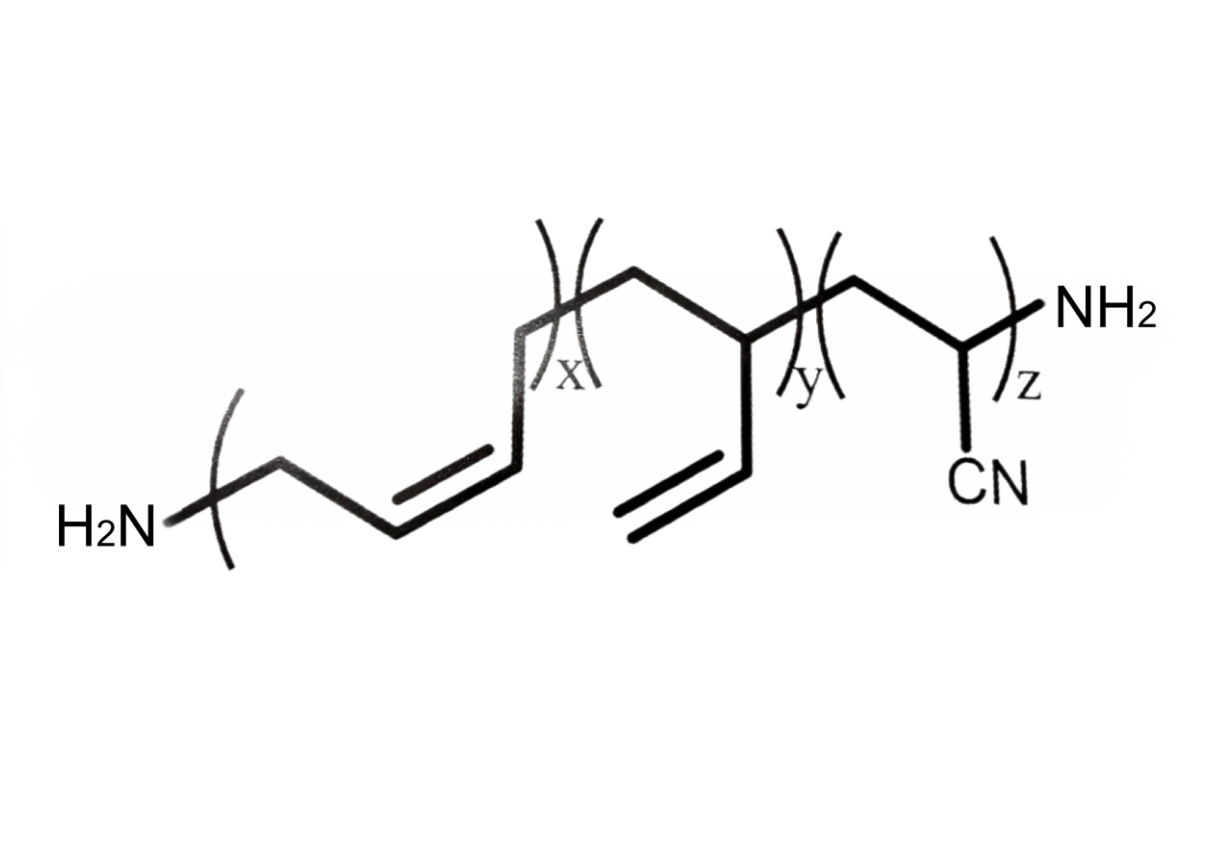
The distinction between CTBN and ATBN forepoxy resin starts with their terminal chemistry. CTBN, or carboxyl-terminated butadiene-acrylonitrile rubber, contains carboxyl groups at the ends of its polymer chains. ATBN, or amine-terminated butadiene-acrylonitrile rubber, uses amine groups instead.
The butadiene-acrylonitrile backbone gives both materials rubber-like flexibility, but the terminal groups determine how each material interacts with the surrounding resin and curing system.
This matters because epoxy formulations are chemically active systems. During curing, epoxy groups react with functional groups supplied by the curing agent or other reactive components. Introducing a functionalized liquid rubber changes the local reaction environment rather than simply adding a soft phase to an otherwise unchanged resin.
The type and concentration of terminal groups can influence cure behavior, network formation, phase separation, and the point at which the rubber becomes less compatible with the growing epoxy network.
CTBN and the balance between toughness and rigidity
CTBN for epoxy resin is widely considered when the main objective is to improve fracture toughness while retaining a useful level of strength and rigidity. As the epoxy cures, CTBN can become increasingly incompatible with the developing epoxy-rich phase. Under controlled conditions, this can lead to dispersed rubber-rich domains within the continuous epoxy matrix.
These domains are important because a crack moving through a brittle epoxy network does not simply encounter a softer material. The rubber phase changes how mechanical energy is distributed around the crack tip. Depending on formulation and morphology, crack deflection, localized deformation, cavitation, and shear yielding can all contribute to higher fracture energy.
That mechanism is fundamentally different from simply lowering the hardness of the adhesive. A successful CTBN epoxy toughening formulation creates a microstructure in which the rubber phase absorbs and redistributes energy while the epoxy phase continues to provide structural support.
For customers evaluating a dedicated reactive rubber for epoxy modification, the CTBN Carboxyl-Terminated Nitrile Butadiene Rubber page provides a useful product-level reference for further formulation work.
ATBN changes the reactive pathway through amine functionality
ATBN for epoxy resin requires a somewhat different formulation approach because terminal amine groups have their own reactivity toward epoxy groups. This can give ATBN a more direct role in the curing reaction and makes the relationship between rubber content, epoxy equivalent weight, curing agent, and final crosslink density particularly important.
The higher chemical reactivity associated with amine functionality can be useful when strong integration between the rubber and epoxy network is required, but ATBN should not be evaluated independently from the curing system.
For this reason, greater terminal reactivity should not automatically be interpreted as a performance advantage. The relevant question is whether that reactivity produces the desired network structure and rubber morphology after curing.
For formulations where amine-terminated rubber is being considered, ATBN Amino Terminated Nitrile Rubber offers a starting point for evaluating the material against the selected epoxy and curing chemistry.
Rubber Phase Morphology Often Determines the Toughening Result
The final performance of a rubber-modified epoxy depends heavily on what happens during phase separation. Before curing, the liquid rubber may appear reasonably well dispersed in the resin. As the epoxy network develops, however, molecular weight increases and the compatibility between the growing epoxy phase and the rubber changes. The system can eventually separate into a continuous epoxy-rich phase containing dispersed rubber-rich domains.
This process is central to epoxy rubber compatibility. If phase separation is too limited, the formulation may not develop enough discrete rubber domains to dissipate fracture energy effectively. If phase separation is excessive, the resulting domains can become too large or poorly distributed, creating weak regions that compromise strength and modulus.
The useful structure lies between these extremes. Rubber domains need to be sufficiently well dispersed to interact with advancing cracks, while their size, interfacial bonding, and distribution must remain compatible with the mechanical requirements of the cured epoxy.
More rubber does not automatically mean more toughness
Increasing the loading of a liquid rubber toughening agent can improve flexibility and fracture resistance up to a certain point, but the relationship is not linear. Higher rubber content can also increase formulation viscosity, lower modulus, alter glass transition behavior, and reduce the strength of the continuous epoxy network.
This creates several formulation trade-offs:
· Fracture toughness may increase while tensile strength decreases.
· Flexibility may improve while modulus falls.
· Rubber loading may increase while processing becomes more difficult.
The optimum loading therefore depends on the intended application. A structural adhesive subjected to repeated impact has different requirements from a casting resin where dimensional stability and high modulus are dominant.
For a broader comparison of reactive rubber options, Reactive Liquid Rubber for Polyurethane and Epoxy Systems provides useful context on how different liquid rubber chemistries fit different polymer systems.
CTBN vs ATBN Is Also a Curing Chemistry Decision
Comparing CTBN and ATBN without considering the curing agent is one of the easiest ways to draw the wrong conclusion. In an actual epoxy formulation, the liquid rubber does not operate alone. Its behavior is influenced by the epoxy resin, curing agent, accelerators, fillers, mixing conditions, and cure schedule.
Formulation Variable | Why It Matters |
Epoxy functionality | Determines the number of available reactive sites and network density |
CTBN or ATBN functionality | Influences how the rubber interacts with the curing system |
Curing agent | Controls the dominant reaction pathway and final network structure |
Rubber loading | Affects morphology, toughness, modulus, and viscosity |
Cure temperature | Influences reaction rate and phase development |
Mixing conditions | Affect dispersion and the uniformity of the final rubber phase |
This is particularly important for ATBN because its amine functionality can directly influence the epoxy reaction. The formulation cannot be treated as if the ATBN were an inert rubber additive. Its contribution needs to be considered when establishing the overall reactive balance.
CTBN also requires careful evaluation, but its carboxyl functionality creates a different interaction with the epoxy and curing system. Consequently, the best CTBN vs ATBN comparison is not a simple test in which equal amounts of each material are added to the same formulation. A meaningful comparison should give each material a formulation that accounts for its own chemical functionality.
When CTBN Makes More Sense for Epoxy Toughening
CTBN is a strong candidate when the central requirement is improved fracture toughness in a relatively rigid epoxy matrix. Structural adhesives are a typical example. The adhesive needs to maintain sufficient stiffness and load-bearing capacity while becoming more tolerant of defects, impact, and repeated stress.
In these systems, the rubber-rich phase created by CTBN can act as an energy-dissipating mechanism around developing cracks. This is particularly valuable when the adhesive is expected to experience mechanical fatigue rather than a single static load.
The formulation can be adjusted to balance rubber-domain formation with the stiffness of the continuous epoxy phase. This is why CTBN toughening is generally a formulation problem rather than a simple additive-selection problem.
Further's existing CTBN Toughening Agent for High Performance Epoxy Resin article can also support customers who need to evaluate CTBN specifically from an epoxy toughening perspective.
When ATBN Deserves Evaluation
ATBN becomes particularly interesting when the formulation can take advantage of amine functionality and when the curing chemistry supports that interaction. The amine-terminated structure can provide a different route for incorporating rubber functionality into the developing epoxy network, which may be useful when chemical integration and adhesion are important considerations.
However, this same reactivity means that ATBN epoxy toughening requires careful formulation control. The amount of ATBN cannot be considered separately from the available epoxy functionality and curing-agent balance. Changes that appear minor at the formulation stage can influence gel time, crosslink density, phase morphology, and the final glass transition temperature.
For this reason, ATBN should be evaluated as part of the complete reactive system rather than treated simply as a softer alternative to CTBN.
What Should Actually Be Measured in a CTBN and ATBN Comparison
A meaningful comparison should extend well beyond tensile strength. Since the purpose of rubber modification is usually to change fracture behavior, the testing program needs to measure the properties that reveal whether the modified network can tolerate damage.
Fracture toughness is one of the most useful indicators because it shows how much energy the material can absorb as a crack develops. Fatigue testing provides another important layer of information for adhesives exposed to vibration or cyclic loading. Thermal analysis, including glass transition behavior, helps determine whether the toughening modification has changed the service temperature range.
Processing characteristics also deserve attention. A material that delivers excellent toughness but produces an impractically viscous formulation may not be suitable for automated dispensing or large-scale production. Dispersion quality, cure time, pot life, and storage stability can all become commercial constraints.
A practical evaluation should therefore consider:
· Mechanical performance: fracture toughness, tensile strength, modulus, impact resistance, and fatigue behavior.
· Thermal performance: glass transition temperature, thermal cycling stability, and resistance to long-term heat exposure.
· Processing behavior: viscosity, mixing, dispersion, pot life, and cure conditions.
The important point is that a toughening agent should be judged by the properties of the cured polymer system, not by its liquid-state specification alone.
CTBN vs ATBN: A Practical Selection Framework
There is no universal winner in the CTBN vs ATBN comparison. CTBN may be the better starting point when the formulation is primarily focused on fracture toughness, controlled rubber-phase formation, and fatigue resistance in a rigid epoxy matrix.
ATBN deserves evaluation when the formulation can benefit from amine reactivity and when the curing chemistry allows that functionality to be used effectively.
For a development team deciding between the two, the most useful questions are usually more specific than “Which rubber is better?”
Application Requirement | Starting Point | Main Formulation Question |
Higher fracture toughness in rigid epoxy | CTBN | Can the rubber phase form with the required size and dispersion? |
Toughening with amine functionality | ATBN | How will amine groups affect epoxy stoichiometry and cure? |
Adhesive exposed to cyclic loading | CTBN or ATBN | Which system provides better fatigue and crack-growth resistance? |
High-modulus structural epoxy | CTBN | How much rubber can be added without excessive modulus loss? |
Reactive integration with epoxy chemistry | ATBN | Does the additional functionality improve the cured network? |
Production-scale formulation | CTBN or ATBN | Can viscosity, mixing, pot life, and cure remain within process limits? |
When the application has demanding requirements for toughness, modulus, thermal performance, and processing at the same time, screening both materials may be more appropriate than selecting one from a datasheet.
The comparison should be made at the formulation level, with resin type, curing agent, rubber concentration, cure schedule, and morphology all taken into account.
The Better Choice Is the One That Produces the Right Cured Structure
CTBN and ATBN both provide valuable routes to improve epoxy toughness, but their effects cannot be separated from the chemistry of the surrounding formulation. Terminal functionality influences reactivity. Reactivity affects phase development and crosslinking. Phase morphology influences crack behavior. Those structural changes ultimately determine whether the cured adhesive survives impact, fatigue, thermal cycling, and long-term mechanical stress.
For formulators working with rubber modified epoxy systems, this is the key distinction between simply adding a flexible polymer and designing an effective toughening system. The most reliable selection combines chemical compatibility, controlled phase morphology, appropriate crosslink density, and realistic service-condition testing.
For customers evaluating reactive liquid rubber for epoxy formulations, Shanghai Further New Material Technology Co., Ltd. supplies CTBN and ATBN materials for different formulation requirements. Its broader Advanced Polyurethane Materials portfolio also covers HTPB, CTPB, EHTPB, hydrogenated HTPB, and other reactive liquid rubber materials, giving formulators more options when the required performance cannot be achieved with a single rubber chemistry.
The right choice between CTBN and ATBN ultimately depends on the cured polymer structure, not simply the name or standalone specification of the liquid rubber.

 English
 English
  Spanish
  Russian
  Arabic
  French
  German
  Portuguese
  Turkish
  Dutch
Dutch  Polish
  Korean
  Vietnamese
  Indonesian
 14. Aug, 2026