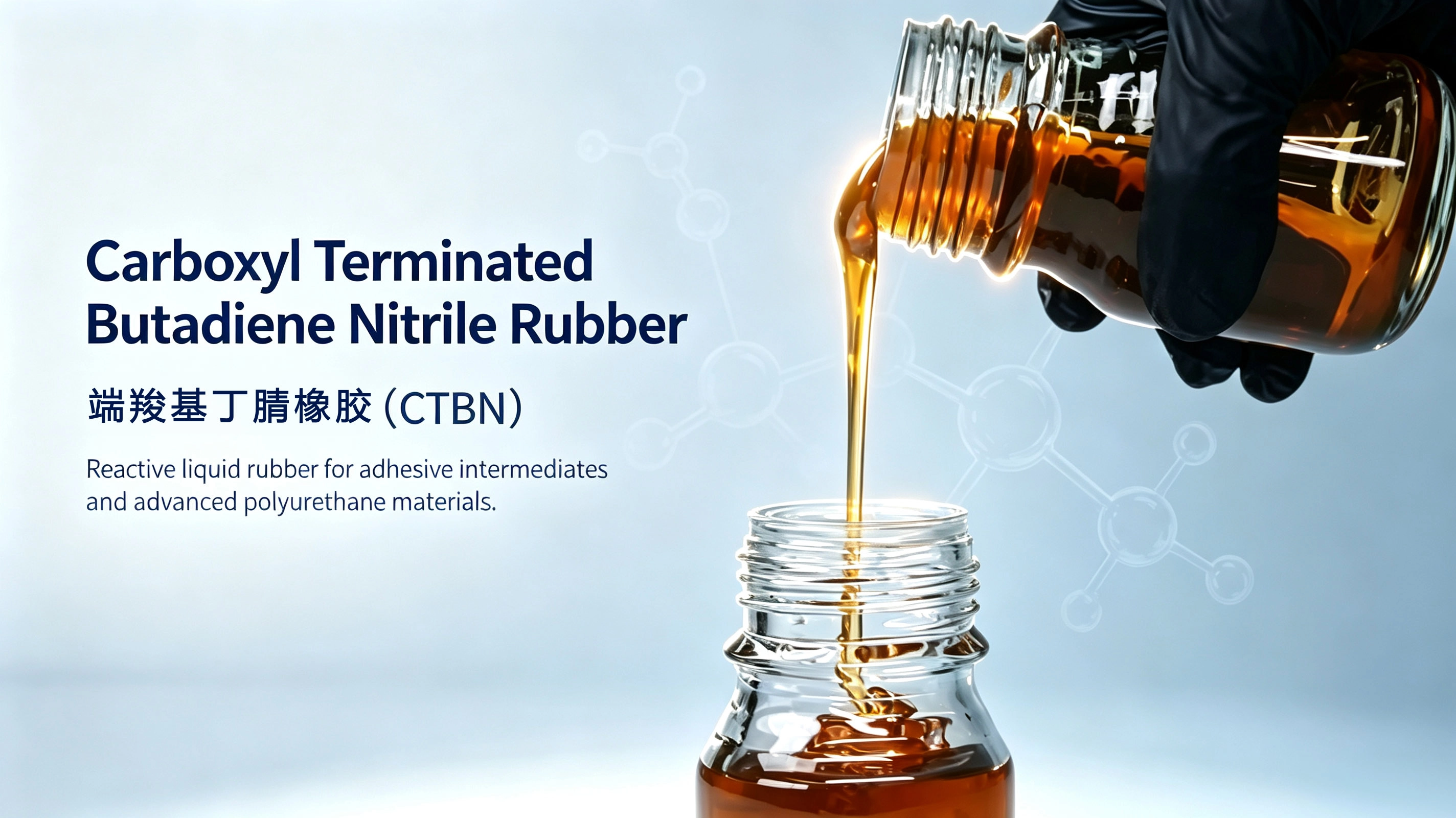
What is Carboxy-Terminated Nitrile Butadiene Rubber?

CTBN Structure and Properties
Further Chem offers carboxy-terminated nitrile butadiene rubber as a versatile solution for enhancing material properties. CTBN is a low-molecular-weight copolymer created by combining butadiene, acrylonitrile, and carboxylic acid monomers. This process results in a unique structure with carboxyl groups at both ends of the molecular chain. The telechelic nature of CTBN allows it to react with other polymers, making it highly compatible with epoxy systems.
The acrylonitrile content in CTBN ranges from 8% to 28%, which can be tailored for specific applications. This content influences toughness and adhesion. Lower acrylonitrile levels improve impact strength and flexibility, while higher levels enhance thermal resistance. The glass transition temperature (Tg) of CTBN falls between -50°C and -30°C, providing excellent low-temperature performance.
CTBN stands out from standard nitrile rubber because its carboxyl groups boost adhesion, mechanical strength, and resistance to heat and chemicals. These features make CTBN suitable for demanding environments.
| Property | Value Range |
|---|
| Acid value | 15–60 mg KOH/g |
| Viscosity | 10–200 Pa·s at 27°C |
| Acrylonitrile content | 15–40 wt% |
| Onset degradation temperature | 220°C to 280°C |
| Compatibility with epoxy resins | δ ≈ 20–22 MPa^0.5 |
Key Features for Epoxy Toughening
CTBN provides several advantages when used to modify epoxy. Its carboxyl groups enable reactions such as epoxy ring-opening, esterification, and amidation. These reactions form strong chemical bonds, which improve the toughness and flexibility of the epoxy. CTBN acts as a reactive modifier, enhancing mechanical and thermal properties without reducing adhesive strength.
- The telechelic structure of CTBN helps create a biphasic morphology in rubber-modified epoxy resins. This structure leads to smaller rubber particles, which are important for achieving desired mechanical properties.
- CTBN improves impact resistance, crack resistance, and peel strength in epoxy systems.
- The material also increases durability and resistance to humidity, heat, and oil.
CTBN’s ability to toughen epoxy makes it valuable in aerospace, electronics, and automotive applications. Its performance in these areas demonstrates why industries rely on Further Chem’s CTBN for high-performance solutions.
CTBN and Epoxy Interaction
Chemical Reaction Mechanisms
Carboxy-Terminated Nitrile Butadiene Rubber interacts with epoxy resins through several important chemical processes. The carboxyl groups at the ends of the CTBN chains react with the epoxy resin during curing. This reaction forms strong chemical bonds, which help anchor the rubber within the epoxy matrix. The functionalized structure of CTBN improves its compatibility with the epoxy prepolymer. As a result, CTBN disperses evenly throughout the resin.
- CTBN participates in crosslinking reactions with the epoxy, which strengthens the final material.
- The curing process triggers a reaction-induced phase separation. This leads to the formation of small, spherical rubber particles within the epoxy.
- These particles become well-distributed, which enhances the overall performance of the cured product.
The combination of crosslinking and phase separation creates a tough, flexible network. This network supports the mechanical strength and durability of the epoxy.
Physical Toughening Effects
The physical structure of the modified epoxy changes as rubbery domains form during curing. These domains play a key role in improving the material’s resistance to cracking and impact.
- Rubbery domains help dissipate energy when the material experiences stress or deformation.
- They act as barriers that slow down or stop cracks from spreading through the epoxy.
- Mechanisms such as stress concentration, cavitation, and crazing work together to prevent crack growth.
These effects lead to a significant increase in toughness and impact resistance. The improved structure allows the epoxy to absorb more energy before breaking. This enhancement in performance makes CTBN-modified epoxy suitable for demanding applications where durability is essential.
Strength Improvement with CTBN

Performance Data and Studies
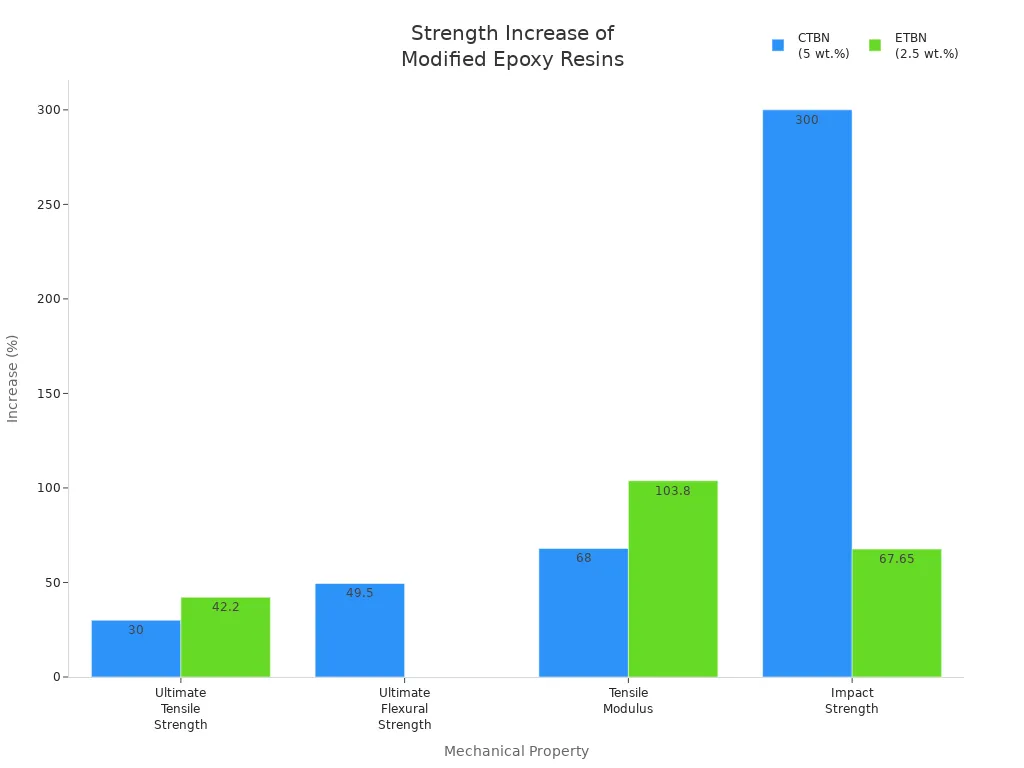
Researchers have measured the effect of carboxy-terminated nitrile butadiene rubber on epoxy mechanical properties. They observed dramatic improvements in impact resistance, tensile strength, and flexural strength. When they added CTBN at 5% by weight, the impact strength of epoxy increased by 300%. Ultimate tensile strength rose by 30%, and flexural strength improved by nearly 50%. Tensile modulus also showed a significant boost.
These results highlight the ability of CTBN to transform the performance of epoxy resins. The rubbery domains formed during curing absorb energy and prevent cracks, which leads to higher durability.
The following table summarizes the quantitative data from scientific studies:
| Property | CTBN (5 wt.%) Increase | ETBN (2.5 wt.%) Increase |
|---|
| Ultimate Tensile Strength | 30% | 42.2% |
| Ultimate Flexural Strength | 49.5% | N/A |
| Tensile Modulus | 68% | 103.8% |
| Impact Strength | 300% | 67.65% |
Further Chem’s product demonstrates similar improvements in mechanical properties. Engineers report that CTBN-modified epoxy resins withstand greater force and resist cracking under stress. These enhancements make CTBN a preferred choice for applications that demand high performance.
Comparison to Unmodified Epoxy
Epoxy resins without toughening agents often show brittle behavior. They break easily under impact or repeated stress. CTBN changes this by introducing flexible domains that absorb energy and slow crack growth.
- CTBN-modified epoxy displays much higher impact resistance than unmodified epoxy.
- The mechanical properties of CTBN-modified epoxy surpass those of resins toughened with other agents, such as carboxyl-terminated polyether and carboxyl-terminated polytetrahydrofuran.
- CTPF-modified resin increases impact strength by 257%, while CTBN achieves a 300% increase.
- CTBN provides superior performance in demanding environments, including aerospace and automotive applications.
The addition of CTBN not only improves impact resistance but also enhances tensile and flexural strength. These improvements extend the service life of epoxy products and reduce maintenance needs.
Manufacturers choose CTBN for its proven ability to boost mechanical properties and performance. The data shows that CTBN triples the impact strength of epoxy, making it a valuable material for industries that require reliability and toughness.
Epoxy Application Benefits
Durability and Impact Resistance
Epoxy resins modified with carboxy-terminated nitrile butadiene rubber show remarkable improvements in durability. These resins resist cracking and maintain structural integrity under repeated stress. The addition of this modifier increases peel strength, which is essential for applications that require strong bonding between surfaces. Enhanced peel strength also means that the adhesive can withstand forces that try to separate bonded materials. Improved crack resistance helps prevent sudden failures, making these resins reliable for demanding environments.
Humidity, heat, and oil can degrade many adhesives over time. Epoxy systems that include carboxy-terminated nitrile butadiene rubber maintain their performance even when exposed to harsh conditions. This stability ensures that composite materials retain their toughness and flexibility. As a result, engineers can trust these materials for long-term use in critical applications.
Industry Uses: Aerospace, Electronics, Automotive
Carboxy-terminated nitrile butadiene rubber-modified epoxy finds use in a wide range of industries. Its unique properties make it a preferred choice for composite materials and structural adhesives. Key application areas include:
- Adhesives, bonding, sealing, spraying, and potting: These processes benefit from the superior adhesion and flexibility of the modified epoxy.
- Automotive components: Gaskets and O-rings made from these materials offer excellent chemical resistance and reliability, supporting vehicle safety.
- Aerospace: The thermal stability and chemical resistance of the modified epoxy ensure consistent performance in aircraft structures and components.
- Electronics: Potting compounds and sealants protect sensitive electronic parts from moisture and mechanical stress.
These benefits allow manufacturers to create products that last longer and perform better in challenging environments. The versatility of this technology supports innovation in composite materials across multiple sectors.
CTBN Formulation Tips
Recommended Dosage and Mixing
When formulating epoxy systems with Carboxy-Terminated Nitrile Butadiene Rubber, manufacturers often use a concentration between 10% and 15%. This range provides a balance between improved toughness and processability. Lower concentrations can enhance flexibility and impact resistance, while higher amounts may affect the viscosity of epoxy systems.
- Mechanical mixing works well for blending CTBN into epoxy systems because the low viscosity of the rubber allows for even dispersion.
- Functionalized CTBN improves adhesion within epoxy systems, resulting in better toughening and enhanced thermal conductivity.
- Pre-reacting CTBN with the epoxy matrix, especially in the presence of triphenylphosphine, can promote strong chemical bonds between carboxyl and oxirane groups.
- The final morphology of epoxy systems depends on phase separation during curing, which creates spherical rubber particles that boost both mechanical properties and thermal conductivity.
- The chemical structure of both CTBN and the epoxy matrix influences the phase-separated morphology, affecting the overall performance of epoxy systems.
The concentration of CTBN also impacts the viscosity and compatibility of epoxy systems. Higher CTBN levels can make processing easier and improve thermal conductivity, which is important for applications that require efficient heat management.
| Property | Neat Epoxy | 15–25% CTBN Modified Epoxy | Improvement |
|---|
| Critical Stress Intensity Factor (K_IC) | 0.6–0.8 MPa·m^0.5 | 1.2–2.5 MPa·m^0.5 | 100–200% increase |
| Fracture Energy (G_IC) | 100–150 J/m² | 400–800 J/m² | Substantial increase |
Storage and Handling Guidelines
Proper storage and handling of CTBN ensure consistent performance in epoxy systems. Further Chem recommends the following guidelines:
- Store CTBN in a cool, dry, and well-ventilated area to maintain its quality and thermal conductivity.
- Keep containers tightly sealed to prevent contamination and preserve the effectiveness of CTBN in epoxy systems.
- The shelf life for high adhesion rubber CTBN is 12 months, while CTBN liquid rubber can last up to 2 years under optimal conditions.
- Packaging options include 50 kg plastic drums and 170 kg metal drums, making it easy to handle and transport for large-scale epoxy systems.
| Product Type | Storage Conditions | Shelf Life |
|---|
| CTBN Liquid Rubber | Cool Dry Place | 2 Years |
| High Adhesion CTBN | Cool Dry Place | 12 Months |
Following these tips helps manufacturers achieve reliable results in epoxy systems, maintain high thermal conductivity, and extend the service life of their products.
Carboxy-Terminated Nitrile Butadiene Rubber has proven to enhance epoxy strength and performance. The table below shows key findings from recent studies:
| Finding | Description |
|---|
| Tensile Strength Increase | The study showed a higher tensile strength increase of up to 40% with 7 wt % XHNTs loading in XNBR/epoxy nanocomposites. |
| Cure Behavior | Higher loading of XHNTs resulted in a rise in the cure rate and a fall in scorch time. |
| Morphology | SEM images indicated a rougher fracture surface with uniform dispersion of nanotubes in the polymer matrix. |
Industries benefit from improved mechanical properties, reduced brittleness, and better impact resistance. CTBN also supports advanced dielectric properties in epoxy systems. Dielectric properties play a crucial role in electronics, aerospace, and automotive applications. Engineers value dielectric properties for reliability and performance. Dielectric properties help maintain insulation and stability. Dielectric properties contribute to safety and efficiency. Dielectric properties ensure long-term durability. Further Chem’s CTBN offers a reliable solution for those seeking high-performance epoxy with superior dielectric properties. Readers can consult experts for formulation advice or explore more resources about dielectric properties.
FAQ
What makes CTBN effective in toughening epoxy resin composites?
CTBN introduces flexible rubbery domains into epoxy resin composites. These domains absorb impact energy and prevent cracks from spreading. This process increases toughness and durability in many industrial applications.
How does CTBN improve compatibility with epoxy systems?
CTBN contains carboxyl groups at both ends of its chain. These groups react with epoxy, which improves compatibility. This reaction ensures even dispersion and strong bonding within the resin.
Can CTBN be used with other additives?
Manufacturers often combine CTBN with other additives. This approach can further enhance performance. However, they should always check compatibility to avoid negative effects on the final product.
What storage conditions does CTBN require?
Store CTBN in a cool, dry, and well-ventilated area. Keep containers tightly closed. Proper storage maintains product quality and ensures reliable results in epoxy applications.
Is CTBN suitable for electronic applications?
CTBN-modified epoxy resists moisture and mechanical stress. This property makes it suitable for electronic potting and sealing. It helps protect sensitive components and extends their service life.

 English
 English
  Spanish
  Russian
  Arabic
  French
  German
  Portuguese
  Turkish
  Dutch
Dutch  Polish
  Korean
  Vietnamese
  Indonesian
 18. Sep, 2026