ATBN Selection Starts With the Failure Mechanism
Selecting an ATBN for epoxy adhesives should begin with the failure occurring in the bonded assembly, rather than with a comparison of product specifications. Epoxy adhesives are valued for their high modulus, chemical resistance, dimensional stability, and strong adhesion, but a highly crosslinked epoxy network can also be susceptible to brittle fracture when a crack reaches a stress concentration. In a composite joint, this problem can become more pronounced because the adhesive is exposed to a combination of shear, peel, impact, vibration, and thermal stresses rather than a single uniform load.
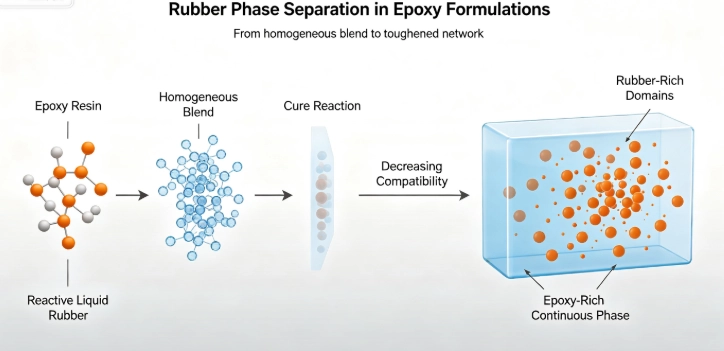
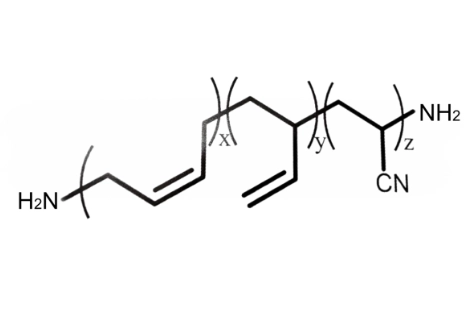
ATBN is used to address this weakness by introducing a reactive rubber component into the epoxy system. Unlike a conventional non-reactive plasticizer, amino-terminated nitrile rubber (ATBN) contains amino end groups that can participate in epoxy curing reactions. Its polybutadiene-based backbone provides the flexible rubber phase, while the terminal amino functionality provides a route for the modifier to interact chemically with the developing epoxy network. The resulting morphology can create additional mechanisms for dissipating energy around a crack tip, making crack initiation and propagation less likely to result in sudden brittle failure.
The important point for formulation engineers is that ATBN is not simply a material that makes epoxy “softer.” The objective is to create a controlled toughening mechanism without sacrificing the properties that made epoxy attractive in the first place. A formulation intended to improve impact resistance may tolerate a greater reduction in modulus than a structural adhesive used for precision composite assemblies. Similarly, an adhesive that fails because of poor substrate wetting or surface preparation will not necessarily benefit from increasing rubber content. The dominant failure mechanism needs to be identified before the ATBN grade is selected.
How ATBN Structure Influences Epoxy Toughening
The performance of ATBN is closely related to its molecular structure. Acrylonitrile content, molecular weight, viscosity, terminal functionality, and the distribution of the rubber phase all influence how the modifier behaves during mixing and curing. These parameters should therefore be evaluated together rather than treating one specification as the deciding factor.
Acrylonitrile content is particularly important because it influences the polarity of the rubber phase and its interaction with the epoxy matrix. A change in polarity can affect compatibility before curing and phase separation during network formation. The resulting morphology has a direct influence on fracture behavior. If rubber domains are too large, they may behave as defects or weak regions rather than effective energy-dissipation sites. If the rubber remains excessively compatible with the epoxy, the discrete rubber morphology required for efficient toughening may not develop as expected.
Molecular weight introduces another trade-off. A higher molecular-weight rubber can provide a stronger elastomeric contribution, but it generally brings higher viscosity and may create difficulties in mixing, dispensing, or incorporating high filler levels. This matters in structural adhesive manufacturing, where the laboratory formulation must eventually pass through pumps, static mixers, automated dispensing equipment, or other production processes. A lower-viscosity grade may be easier to process, but processability alone is not a sufficient reason to select it if the cured adhesive cannot achieve the required crack resistance.
For this reason, a meaningful ATBN comparison should cover several parameters at the same time:
Chemical compatibility: interaction with the selected epoxy resin and curing agent.
Physical properties: molecular weight, viscosity, and rubber content characteristics.
Reactive functionality: contribution of the amino end groups to the curing system.
Processing behavior: mixing, dispensing, storage stability, pot life, and cure response.
ATBN parameter | Influence on epoxy formulation | Practical consideration |
Acrylonitrile content | Affects polarity and rubber/epoxy interaction | Phase morphology and toughness |
Molecular weight | Influences elastomeric contribution and viscosity | Toughening efficiency versus processing |
Viscosity | Controls mixing and dispensing behavior | Equipment capability and filler loading |
Amine functionality | Affects interaction with epoxy curing | Stoichiometry and cure kinetics |
Batch consistency | Determines formulation repeatability | Lot-to-lot quality control |
The most useful grade is therefore not necessarily the one with the highest value in any individual specification. It is the grade whose overall chemical and physical characteristics fit the complete adhesive formulation.
Match ATBN With the Epoxy and Curing System
ATBN cannot be selected independently from the epoxy resin and curing agent. Resin functionality, epoxy equivalent weight, initial viscosity, crosslink density, and cure kinetics all affect how the rubber phase develops as the thermoset network forms.
The curing agent is particularly important because ATBN contains reactive amino groups. The amine-to-epoxy balance influences both the chemical incorporation of the modifier and the structure of the cured network. Cure temperature and time also matter. A rapid high-temperature cure can produce a different morphology from a slower room-temperature or staged cure, even when the same ATBN grade is used at the same concentration.
This is one reason why transferring an ATBN loading directly from one epoxy system to another can produce disappointing results. The same ATBN concentration does not guarantee the same toughening effect. The interaction between rubber functionality, resin chemistry, curing rate, and phase separation determines the final microstructure.
A formulation with excessive phase separation may show a reduction in strength or modulus because the rubber domains become too large. A system with insufficient phase separation may retain a relatively brittle morphology. The useful formulation window lies between these extremes, where the rubber phase can absorb fracture energy without creating an unacceptable loss of structural properties.
The practical approach is to treat the epoxy resin, ATBN, curing agent, accelerator, fillers, and cure schedule as one formulation system. Changing one component should be followed by controlled testing rather than assuming that the previous formulation ratio will remain valid.
Establish the ATBN Loading Window Before Optimizing the Formula
Increasing ATBN concentration does not produce an unlimited increase in toughness. Rubber modification generally involves a balance between fracture resistance and properties such as modulus, tensile strength, glass transition temperature, and dimensional stability. Once the rubber phase exceeds the useful range, additional modifier may provide diminishing toughening benefits while creating increasingly significant compromises elsewhere.
A better development method is to establish an unmodified epoxy baseline and then test several ATBN concentrations under identical curing conditions. The goal is to identify the point at which fracture resistance begins to improve significantly and the point beyond which additional rubber produces unacceptable changes in the rest of the property profile.
For structural epoxy adhesives, the testing program should not rely on tensile strength alone. A formulation can maintain reasonable tensile properties while behaving very differently during crack propagation. Depending on the application, the screening program should include fracture toughness, lap shear, peel or impact performance, elongation, modulus, Tg, and environmental aging.
Processing properties need to be measured alongside mechanical properties. A formulation that delivers excellent toughness but becomes too viscous for the customer's dispensing equipment is not a successful commercial formulation. The same applies to a system with an impractically short pot life or a cure response that cannot be accommodated by the production process.
Composite Bonding Changes the Selection Criteria
Composite bonding places additional demands on an epoxy adhesive because the joint often connects materials with substantially different stiffness and thermal expansion behavior. Carbon fiber reinforced polymer, glass fiber composites, aluminum, steel, and hybrid structures can all generate localized stresses around the edge of the bond line.
A brittle epoxy may perform well under static shear but fail when local peel stresses initiate a crack at the end of the overlap. Once that crack begins to propagate, the adhesive's fracture resistance becomes more important than its initial tensile strength. Properly formulated ATBN can increase the amount of energy required for crack propagation by allowing localized deformation around the crack tip and within the rubber-modified microstructure.
However, higher bulk toughness does not automatically mean better composite bonding. Surface preparation, adhesive wetting, bond-line thickness, substrate roughness, cure pressure, and joint geometry can have an equally important influence on joint performance. If the actual problem is an adhesive-substrate interface failure, increasing ATBN may simply lower the cohesive strength without fixing the interface.
Composite bonding therefore deserves testing at the joint level. A useful validation program can compare the unmodified and ATBN-modified systems using the actual substrates and bond geometry, followed by environmental exposure where relevant. Thermal cycling, moisture conditioning, fatigue loading, and impact testing can reveal differences that are not visible in a room-temperature lap-shear test.
The failure surface should also be examined. A change from sudden brittle cohesive fracture toward a more stable cohesive failure can indicate that the rubber modification is performing its intended function. By contrast, persistent interfacial failure suggests that surface treatment, primer selection, or adhesive chemistry may need attention before further ATBN optimization.
ATBN or CTBN: The Terminal Functionality Matters
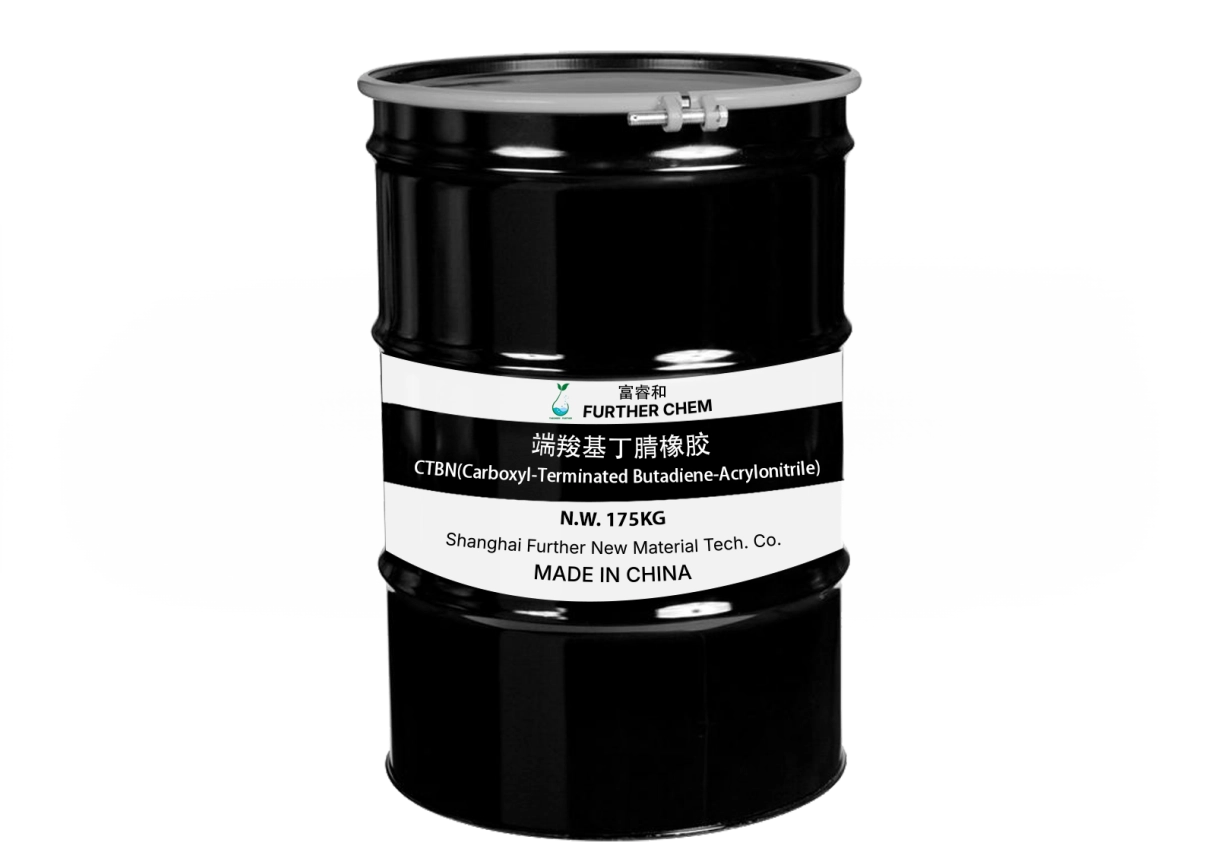
ATBN is often evaluated alongside CTBN when selecting a reactive liquid rubber for epoxy toughening. Although both are used to modify thermoset systems, they should not be treated as interchangeable materials because their terminal functional groups differ.
ATBN contains amino termination, while CTBN contains carboxyl termination. This difference changes the way each modifier interacts with the epoxy and curing chemistry. It can influence reaction behavior, phase separation, formulation viscosity, cure characteristics, and the resulting balance between toughness and structural performance.
The choice should therefore be based on the curing system rather than on a general assumption that one reactive rubber is inherently superior. For formulators comparing these two technologies, the CTBN vs ATBN guide for epoxy resin toughening provides a useful technical reference for understanding the differences in reactive functionality and application considerations.
Once the chemistry has been narrowed down, the selected grade should still be evaluated in the actual epoxy formulation. Resin type, curing agent, filler package, cure schedule, and target bond-line properties can all change the final result.
Processing Can Be the Real Limitation
An ATBN formulation that performs well in laboratory testing may still be unsuitable for commercial production if it creates processing problems. This is particularly relevant for filled structural adhesives, two-component systems, and automated composite bonding processes.
Dispersion is one of the first issues to control. The modifier must be incorporated consistently throughout the resin without creating localized rubber-rich or rubber-poor regions. Poor dispersion can produce unpredictable fracture behavior and increase batch-to-batch variation. Mixing temperature and sequence may therefore need to be controlled as carefully as the final ATBN concentration.
Viscosity should be measured under the conditions that actually matter in production. A formulation that can be stirred manually in a laboratory may behave very differently after fillers, pigments, or other additives are introduced. Storage temperature can also affect viscosity and handling. For two-component systems, the interaction between viscosity, mixing ratio, pot life, and cure kinetics should be checked before a formulation is moved to production trials.
This is why ATBN selection should involve both the formulation engineer and the manufacturing team. The laboratory determines whether the modifier improves the required material properties; production determines whether those properties can be delivered consistently through the intended manufacturing process.
A Practical ATBN Screening Program
For a new epoxy adhesive or composite bonding system, the most efficient approach is usually a controlled screening program rather than a large number of unrelated experiments. Establishing a baseline first makes it much easier to identify what the ATBN is actually changing.
Development stage | Variables to control | Main objective |
Baseline | Unmodified epoxy system | Establish strength, modulus, Tg, and fracture behavior |
Grade screening | Different suitable ATBN grades | Compare chemistry, viscosity, and compatibility |
Loading study | Several ATBN concentrations | Identify the useful toughening window |
Cure study | Practical cure schedules | Evaluate morphology and property sensitivity |
Joint validation | Actual substrates and bond geometry | Confirm real bonding performance |
Durability testing | Heat, moisture, cycling, fatigue, or impact | Verify long-term performance |
This sequence also prevents a common formulation-development problem: changing the ATBN grade, concentration, curing agent, and cure schedule simultaneously and then being unable to determine which variable caused the observed improvement or deterioration.
Once the most promising grade has been identified, optimization can focus on the variables that matter to production, such as filler loading, dispensing viscosity, cure time, and bond-line thickness. For broader reactive liquid rubber selection, the liquid rubber selection guide for high-performance polymer systems can provide additional context when comparing different rubber chemistries for specific polymer requirements.
What to Verify With an ATBN Supplier
Supplier qualification should go beyond requesting a standard product datasheet. For a reactive modifier that becomes part of a structural epoxy formulation, consistency between batches can be as important as the nominal specification.
The technical documentation should provide information relevant to formulation control, such as viscosity, reactive functionality or amine-related characteristics, acrylonitrile content where applicable, molecular-weight information, moisture, appearance, and applicable quality-control parameters. The supplier's technical team should also be able to discuss how the material behaves in epoxy formulations rather than providing only a general product description.
For a production qualification, testing several independent lots under identical formulation conditions can be particularly valuable. If viscosity or reactive functionality varies significantly between batches, the adhesive manufacturer may need to compensate by changing the formulation, which creates unnecessary process variation.
Packaging and storage conditions should also be considered. Reactive liquid rubbers can be sensitive to temperature and long-term storage conditions, so the supplier's recommended handling practices should be compatible with the customer's logistics and production environment.
A reliable ATBN supplier for epoxy adhesives and composite bonding should therefore be evaluated through three levels: consistent raw-material specifications, technical support during formulation development, and demonstrated batch-to-batch quality during qualification.
Selecting ATBN Is a Formulation Decision
The right ATBN is determined by the complete epoxy system and the failure mode that the adhesive needs to withstand. A grade that provides excellent crack resistance in one formulation may produce an unfavorable viscosity, cure response, or thermal-property balance in another.
For demanding epoxy adhesives and composite bonding applications, the more reliable path is to define the failure mechanism first, establish the processing limits, compare suitable ATBN grades, determine the useful concentration window, and then validate the formulation using the actual substrates and service conditions. The objective is not to add as much rubber as possible, but to create the right rubber-modified morphology while preserving the properties required by the finished joint.
That approach gives ATBN a clear role in the formulation: improving resistance to crack initiation and propagation without turning a high-performance epoxy into a system that is difficult to process or unable to meet its structural and thermal requirements.

 English
 English
  Spanish
  Russian
  Arabic
  French
  German
  Portuguese
  Turkish
  Dutch
Dutch  Polish
  Korean
  Vietnamese
  Indonesian
 30. Jun, 2026