Why Brittle Polymers Need Toughening Modifiers
High strength and high stiffness do not necessarily make a polymer resistant to fracture. A cured epoxy, for example, can provide excellent adhesion, dimensional stability, and mechanical strength while remaining vulnerable to impact, peel stress, or crack propagation. Once a crack forms, the material may fail before it can undergo enough deformation to dissipate the applied energy.
This is where liquid rubber modifiers become useful. Incorporated into a polymer formulation, these materials can improve resistance to crack growth and impact damage by introducing a deformable rubber phase into a comparatively rigid matrix. Depending on the chemistry and formulation, they can also improve elongation, flexibility, and stress tolerance.
Several mechanical properties need to be distinguished when evaluating a toughening system:
Stiffness describes resistance to elastic deformation, commonly measured by the elastic modulus.
Strength indicates the stress a material can withstand before yielding or failing under a specified test.
Toughness describes the energy absorbed before fracture under defined loading conditions.
Fracture toughness measures resistance to the initiation or propagation of a crack under a specified fracture-mechanics test.
These properties are related, but they are not interchangeable. A formulation can become more flexible without achieving a substantial increase in fracture toughness. Likewise, a material may resist crack propagation more effectively while retaining much of its original stiffness.
The objective of polymer toughening is therefore not simply to soften the matrix. It is to change how the material responds to stress and how much energy it can absorb before failure. Liquid rubber modification is particularly valuable when brittle fracture limits the performance of an otherwise suitable polymer.
How Liquid Rubber Modifiers Improve Fracture Resistance
The effectiveness of liquid rubber toughening depends on more than the inherent elasticity of the modifier. Its compatibility with the polymer, chemical functionality, dispersion, and behavior during curing all influence the resulting microstructure and mechanical response.
Phase Separation and Rubber-Rich Domains
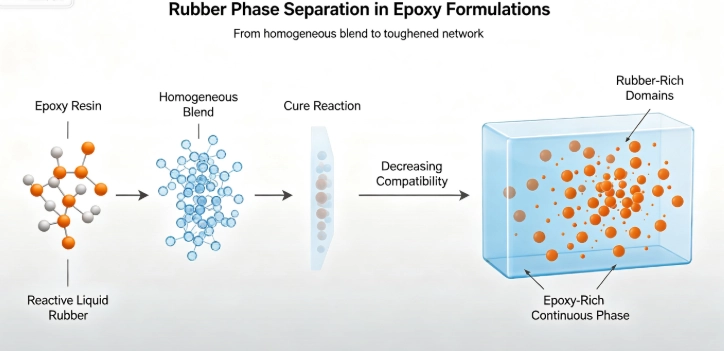
In reactive thermosetting systems, some liquid rubber modifiers are initially compatible with the uncured resin. As curing progresses, increasing molecular weight and the development of the crosslinked network can reduce compatibility, causing the rubber-rich phase to separate from the matrix.
This process, known as reaction-induced phase separation, can produce dispersed rubber domains within the cured polymer. The final morphology depends on the modifier's molecular structure, functional groups, concentration, resin chemistry, and cure schedule.
The distinction between initial compatibility and final morphology is important. A modifier that blends readily into a liquid resin does not necessarily produce the most effective cured structure. Conversely, excessive incompatibility can cause poor dispersion or premature separation, making processing and property consistency difficult to control.
The goal is to develop a morphology that allows the rubber phase to contribute to energy dissipation while maintaining sufficient interaction with the surrounding polymer. Research on rubber-toughened epoxy systems identifies rubber concentration, particle morphology, matrix ductility, and the particle–matrix interface as important factors governing toughening efficiency. See the critical review of rubber-toughened epoxies.
Not every liquid rubber system follows the same phase-separation pathway. Some formulations remain more homogeneous, while others use preformed rubber particles or alternative morphologies. The appropriate structure depends on the material chemistry and intended performance.
Cavitation, Shear Yielding, and Crack Growth
When a rubber-modified polymer is loaded, the dispersed rubber domains can alter the stress field around an advancing crack. Instead of allowing the crack to propagate through a relatively brittle matrix with limited energy absorption, the modified structure can activate additional deformation mechanisms.
Two important mechanisms in rubber-toughened thermosets are rubber-particle cavitation and matrix shear yielding.
Cavitation involves the formation of internal voids within rubber domains or near their interfaces under suitable stress conditions. This local change in the stress field can facilitate plastic deformation of the surrounding matrix. Shear yielding allows the matrix to deform in localized regions, absorbing energy that would otherwise contribute more directly to crack propagation.
The mechanisms may operate together, and their relative contributions depend on the rubber phase, interface, matrix properties, particle dimensions, and loading conditions. They should not be treated as universal explanations for every liquid rubber-modified polymer.
For formulators, the practical implication is that effective liquid rubber toughening depends on the interaction between the modifier and the matrix, not simply on adding a soft ingredient. Rubber content alone cannot predict the result without considering the structure formed during processing and curing.
Toughness, Flexibility, and Stiffness: What Changes in Practice?
Adding a liquid rubber modifier changes the balance of mechanical properties. The outcome depends on the modifier chemistry, loading level, matrix, and degree of interaction between the two phases.
Property | Potential effect of liquid rubber modification | What to verify |
Fracture toughness | Greater resistance to crack initiation or propagation | Appropriate fracture test and specimen geometry |
Impact resistance | Improved energy absorption under impact loading | Impact strength under relevant test conditions |
Elongation at break | May increase as deformation capacity improves | Tensile testing and failure mode |
Elastic modulus | May decrease as a softer phase is introduced | Initial stiffness and application requirements |
Tensile strength | May increase, decrease, or remain similar | Matrix chemistry, interface quality, and modifier loading |
Glass transition temperature (Tg) | May change with network structure and formulation | DSC or DMA under consistent conditions |
Viscosity and processability | May become less favorable at higher modifier concentrations | Mixing, dispensing, coating, and curing requirements |
These are possible trends rather than guaranteed outcomes. A well-designed toughening system may improve fracture resistance while retaining much of the matrix stiffness, but this requires appropriate chemistry and morphology. Other systems may trade some modulus or glass transition temperature for improved flexibility.
It is also important to distinguish flexibility from toughness. A flexible polymer can deform considerably but still tear or fail under a particular loading condition. A toughened polymer, by contrast, is designed to dissipate more energy before fracture. The two objectives can overlap, but they require different performance criteria.
For structural adhesives, fracture toughness and peel resistance may be more relevant than elongation alone. For an elastomeric polyurethane, flexibility, tensile behavior, and cyclic deformation may carry greater weight. The correct evaluation method should reflect the actual failure mode in service.
How Liquid Rubber Behaves in Different Polymer Matrices
A liquid rubber modifier cannot be selected solely on the basis of results reported for another resin. Polymer chemistry determines how the modifier interacts with the matrix, whether it reacts during curing, and what morphology develops in the finished material.
Epoxy Resins and Structural Adhesives
Cured epoxy networks often combine high stiffness and strong adhesion with limited resistance to crack propagation. Liquid rubber modification can address this weakness by introducing a deformable phase that promotes energy-dissipating mechanisms around a crack.
Reactive liquid rubbers may contain functional groups that participate in or interact with the curing chemistry. Their molecular architecture and compatibility influence whether they remain dispersed, form rubber-rich domains, or produce other structures during cure.
For epoxy formulations, carboxyl-terminated butadiene acrylonitrile rubber (CTBN) is one example of a reactive liquid rubber used for toughening. Its suitability depends on the epoxy formulation, curing agent, reaction conditions, and required balance between toughness and other properties. CTBN should not be assumed to be the best choice for every epoxy system.
The practical objective is to increase resistance to fracture without compromising the properties that make epoxy useful, such as adhesion, stiffness, thermal performance, and dimensional stability. Where these properties must be retained, the modifier concentration and cured morphology require particular attention.
Further information on CTBN for epoxy modification can help place this modifier within the broader range of reactive liquid rubber materials.
Polyurethane and Other Polymer Systems
Polyurethane formulations present a different set of considerations. Their properties depend on the polyol and isocyanate chemistry, functionality, equivalent ratio, crosslink density, and curing conditions. Liquid rubber modification must be assessed in relation to these variables rather than treated as a direct extension of epoxy toughening.
In polyurethane systems, the desired outcome may be greater flexibility, improved resistance to cracking, enhanced impact tolerance, or better performance under repeated deformation. Whether a liquid rubber modifier can deliver these benefits depends on its chemical functionality and compatibility with the polyurethane formulation.
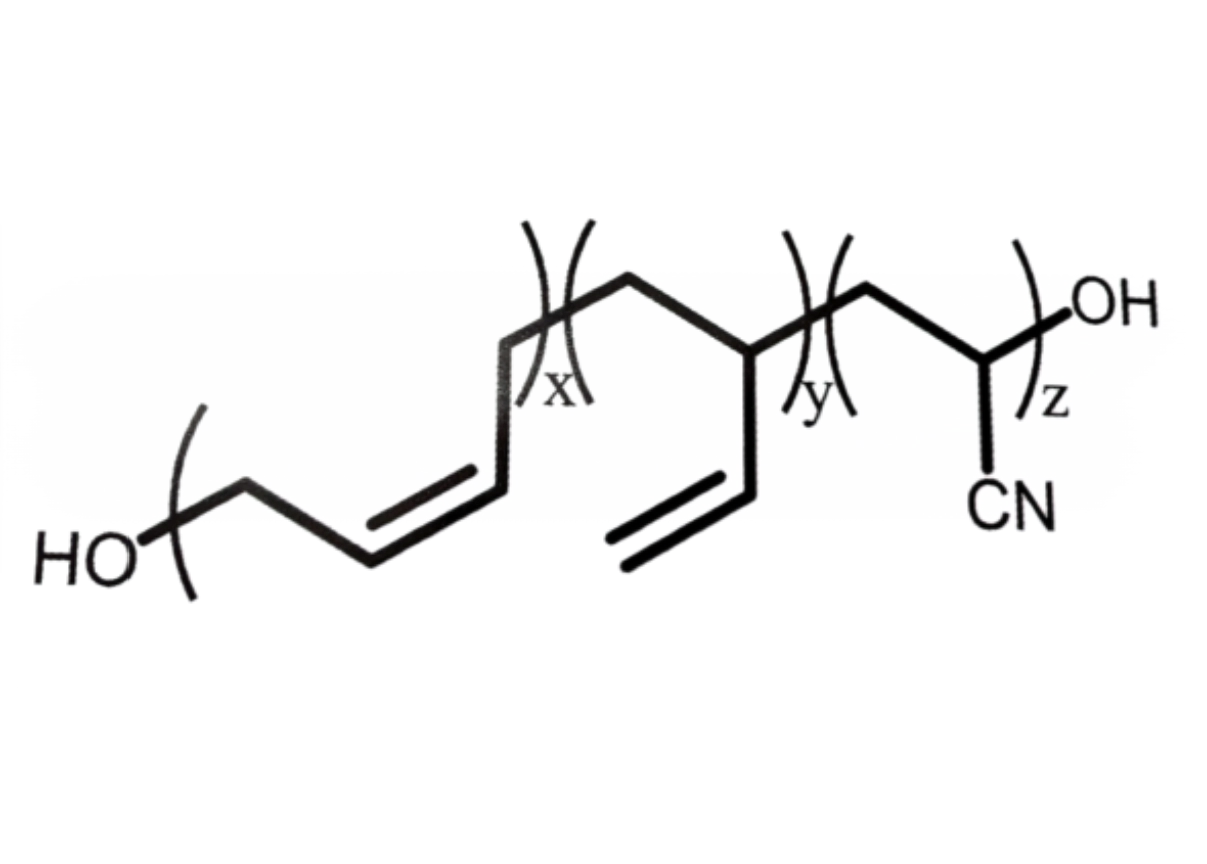
For example, hydroxyl-functional liquid polybutadiene may be relevant to polyurethane formulations where hydroxyl groups participate in the isocyanate reaction. However, its influence on the final network depends on functionality, molecular weight, equivalent ratio, and the properties of the other formulation components.
Other polymer matrices may require different modifier chemistries or compatibilization strategies. Results obtained with a reactive liquid rubber in epoxy cannot automatically be transferred to polyurethane, polyester, or thermoplastic systems.
Polymer matrix | Typical modification objective | Key variables to evaluate |
Epoxy resin | Improve fracture toughness and impact resistance | Functional groups, phase separation, rubber-domain morphology, cure schedule |
Structural adhesives | Improve peel and fracture resistance while retaining adhesion | Bondline thickness, substrate, joint geometry, cohesive failure behavior |
Polyurethane | Adjust flexibility and resistance to cracking or deformation | Modifier functionality, equivalent ratio, crosslink density, compatibility |
Other polymer systems | Improve resistance to impact or brittle failure | Matrix chemistry, dispersion, interfacial adhesion, processing conditions |
The best starting point is the matrix's actual performance limitation. If a material fails through crack propagation, a toughening strategy may be appropriate. If it lacks flexibility, the formulation may require a different balance of soft segments, crosslink density, or reactive components.
Formulation Variables That Determine Final Performance
Even a suitable liquid rubber modifier can produce disappointing results when its concentration, compatibility, or processing conditions are poorly matched to the polymer system.
Modifier loading is one of the first variables to investigate. Increasing the rubber content may improve energy absorption up to a certain point, but further additions can reduce stiffness, tensile strength, thermal performance, or processability. The optimum concentration is formulation-specific rather than a universal percentage.
Compatibility and morphology are equally important. The modifier must disperse adequately and develop a structure that contributes to the intended mechanical response. Poor dispersion, excessive domain growth, or weak interfacial interaction can undermine the benefits of adding rubber.
Curing conditions also affect the final result. In reactive systems, temperature, reaction rate, and cure schedule influence the evolution of the network and the morphology of the rubber phase. Changes in these conditions can alter the balance between compatibility, phase separation, and network development.
Before adjusting the formulation, check the following:
Chemical compatibility: Determine whether the modifier is miscible, reactive, or prone to premature separation under the actual mixing and curing conditions.
Loading and viscosity: Evaluate whether the modifier concentration provides the desired property change without making mixing, dispensing, coating, or impregnation impractical.
Cure behavior: Check whether the modifier changes cure kinetics, network development, or the final glass transition temperature.
Dispersion and morphology: Look for agglomeration, inconsistent rubber-domain distribution, or evidence of an unsuitable phase structure.
Property balance: Compare toughness gains against changes in modulus, tensile strength, elongation, adhesion, and thermal performance.
These variables should be assessed together. For instance, increasing the modifier loading may improve impact resistance but also increase viscosity and reduce stiffness. A formulation that performs well in a laboratory specimen may therefore be unsuitable for a manufacturing process that requires rapid dispensing or a thin, uniform bondline.
How to Evaluate a Liquid Rubber Toughening System
The effectiveness of a liquid rubber toughener should be demonstrated through controlled comparison, not inferred from its chemical structure or from a single improved test result.
Start with an unmodified reference formulation and compare it with modified samples prepared under consistent mixing, curing, conditioning, and specimen-preparation conditions. Change the modifier loading systematically so that the relationship between concentration and performance can be established.
The test program should reflect the application. Fracture toughness testing can be useful when crack propagation is the principal concern, while impact testing addresses performance under specified impact conditions. Tensile testing helps establish whether improvements in deformation capacity come with changes in strength or modulus. For adhesives, peel or other bond-specific tests may be more informative than tensile properties measured on bulk material.
Thermal analysis and rheological measurements can provide additional insight into the formulation. Differential scanning calorimetry (DSC) or dynamic mechanical analysis (DMA) can help evaluate changes in thermal transitions and viscoelastic behavior. Viscosity measurements are useful for determining whether the modified formulation remains suitable for production.
A practical evaluation should establish:
1. A defined failure mode. Identify whether the priority is crack propagation, impact damage, peel failure, low-temperature brittleness, or another limitation.
2. Comparable test conditions. Keep specimen geometry, cure history, conditioning, and test methods consistent across the reference and modified formulations.
3. A balanced property profile. Record toughness-related results alongside stiffness, strength, elongation, thermal behavior, and processability.
4. Repeatable performance. Confirm that the observed improvement persists across repeat samples and relevant manufacturing conditions.
A successful liquid rubber modification is not necessarily the formulation with the highest impact strength or the greatest elongation. It is the formulation that resolves the target failure mechanism while retaining the properties and processing characteristics required for the application.
For material developers, the most productive approach is to treat liquid rubber modification as a matrix-specific design task. Modifier chemistry establishes the potential for interaction; loading, curing, and morphology determine how that potential is realized. Evaluating these factors together provides a more reliable basis for improving toughness and flexibility in demanding polymer systems.

 English
 English
 Spanish
 Russian
 Arabic
 French
 German
 Portuguese
 Turkish
 Dutch
 Polish
 Korean
 Vietnamese
 Indonesian
 28. Sep, 2026