Why Dynamic Adhesive Loads Require a Different Selection Strategy
An adhesive that performs well under static loading can behave very differently when a bonded joint is exposed to repeated shear, peel, vibration, impact, or thermal-mechanical cycling. Under these conditions, the adhesive is not simply carrying a load. It is repeatedly storing and releasing strain energy, redistributing stress, and resisting the initiation and growth of cracks.
That makes reactive liquid rubber selection more than a question of which modifier provides the highest elongation or impact strength. The useful material is the one that can develop an appropriate rubber morphology, interact effectively with the adhesive matrix, dissipate mechanical energy, and remain compatible with the required processing and curing conditions. A review of available reactive liquid rubber materials can help establish the relevant material families before moving into formulation-specific screening.
The selection process should therefore start with the service condition rather than the product name. The key question is: what type of rubber chemistry, functionality, molecular weight, and loading can provide the required response to the actual dynamic load without compromising the rest of the adhesive system?
What Makes Reactive Liquid Rubber Useful Under Cyclic Loading
Dynamic adhesive failure often develops progressively. Small defects, voids, interfaces, and areas of local stress concentration can become crack initiation sites. Once a crack forms, repeated loading can drive it through the adhesive layer or along the adhesive-substrate interface.
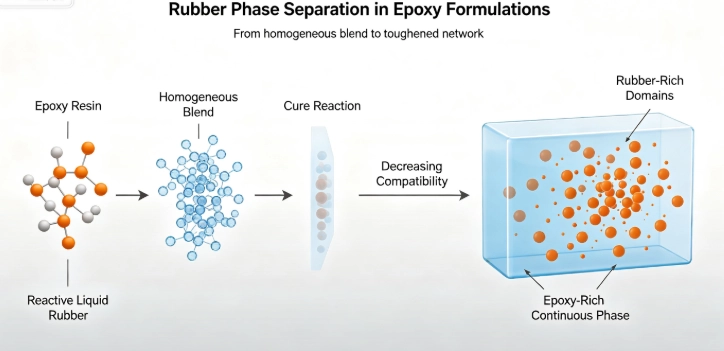
A reactive liquid rubber can change this process by introducing a dispersed rubber phase into the cured polymer network. Depending on the chemistry and morphology, the rubber phase can promote localized deformation and energy dissipation around a developing crack. Crack deflection, rubber cavitation, matrix shear deformation, and other toughening mechanisms may contribute to improved resistance to crack growth.
This is why adhesive fatigue resistance cannot be predicted reliably from tensile strength alone. A formulation with high static strength may still experience rapid fatigue crack growth, while a somewhat more compliant formulation may survive repeated loading for longer because it dissipates mechanical energy more effectively.
Energy Dissipation Matters More Than Maximum Strength
Under cyclic loading, stress becomes concentrated around defects and crack tips. If the surrounding material cannot accommodate the local strain, the crack can extend with each loading cycle.
A rubber-modified adhesive can absorb part of this energy through deformation of the rubber phase and the surrounding matrix. The goal, however, is not simply to soften the adhesive. Excessive softening can reduce modulus, cohesive strength, creep resistance, and dimensional stability.
The useful formulation window is where the rubber phase provides sufficient energy dissipation while the continuous matrix retains the mechanical properties needed by the joint.
For this reason, crack propagation and fracture behavior are often more useful selection criteria than elongation at break when the adhesive will operate under repeated mechanical loads.
Why Reactive Liquid Rubber Is Different From a Nonreactive Plasticizer
A nonreactive plasticizer can increase flexibility by reducing intermolecular interactions or lowering the effective glass-transition behavior of a polymer system, but it does not necessarily become chemically integrated into the cured network. Depending on the formulation, this can affect long-term stability, cohesive strength, migration resistance, and environmental durability.
Reactive liquid rubber is different because its terminal functional groups can participate in the adhesive's curing chemistry. The rubber therefore becomes part of the final network to some extent rather than acting only as a physically blended soft phase.
That makes terminal functionality a critical selection parameter. The compatibility of the functional groups with the resin and curing system determines how the rubber participates in network formation and how the final morphology develops.
Match the Rubber Chemistry to the Adhesive Chemistry
The first screening step in reactive liquid rubber selection should be chemical compatibility. A modifier that performs well in one adhesive family cannot automatically be transferred to another.
Terminal groups, backbone structure, polarity, molecular weight, and curing chemistry all influence how the liquid rubber behaves during mixing and cure. The modifier therefore needs to be evaluated as part of the complete adhesive formulation.
CTBN for Epoxy-Based Adhesives
CTBN for epoxy adhesives is commonly considered when the objective is to increase fracture toughness while retaining the strength and thermal characteristics of a thermoset epoxy matrix.
CTBN contains carboxyl functionality and a butadiene-based backbone. Its acrylonitrile content can influence polarity, viscosity, resin interaction, and the morphology formed during curing. These variables become particularly important when the adhesive must withstand repeated mechanical loading.
The selected CTBN should therefore be evaluated against the specific epoxy resin, curing agent, rubber loading, cure schedule, and target morphology. Initial compatibility is not enough. The final cured structure determines how the rubber phase contributes to crack resistance.
ATBN When Terminal Functionality Changes the Interaction
ATBN for epoxy adhesives provides another approach to rubber modification. Its amine-terminated structure creates different interactions with epoxy resin and curing chemistry compared with carboxyl-terminated liquid rubber.
This distinction can affect reaction behavior, phase separation, interfacial bonding, and the structure of the cured network. The same rubber concentration can produce different mechanical results depending on the terminal functionality and the rest of the formulation.
ATBN should therefore be selected according to the complete epoxy system rather than treated as a direct one-for-one substitute for CTBN.
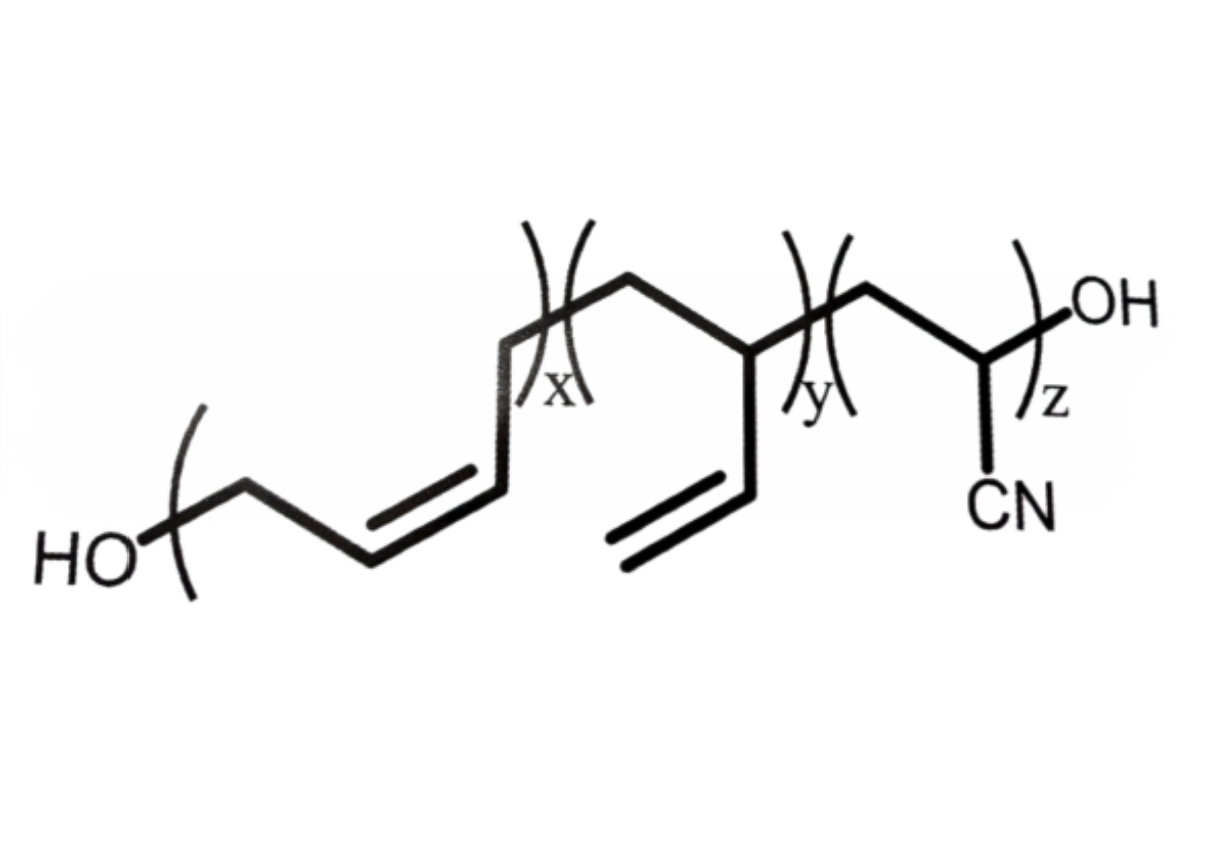
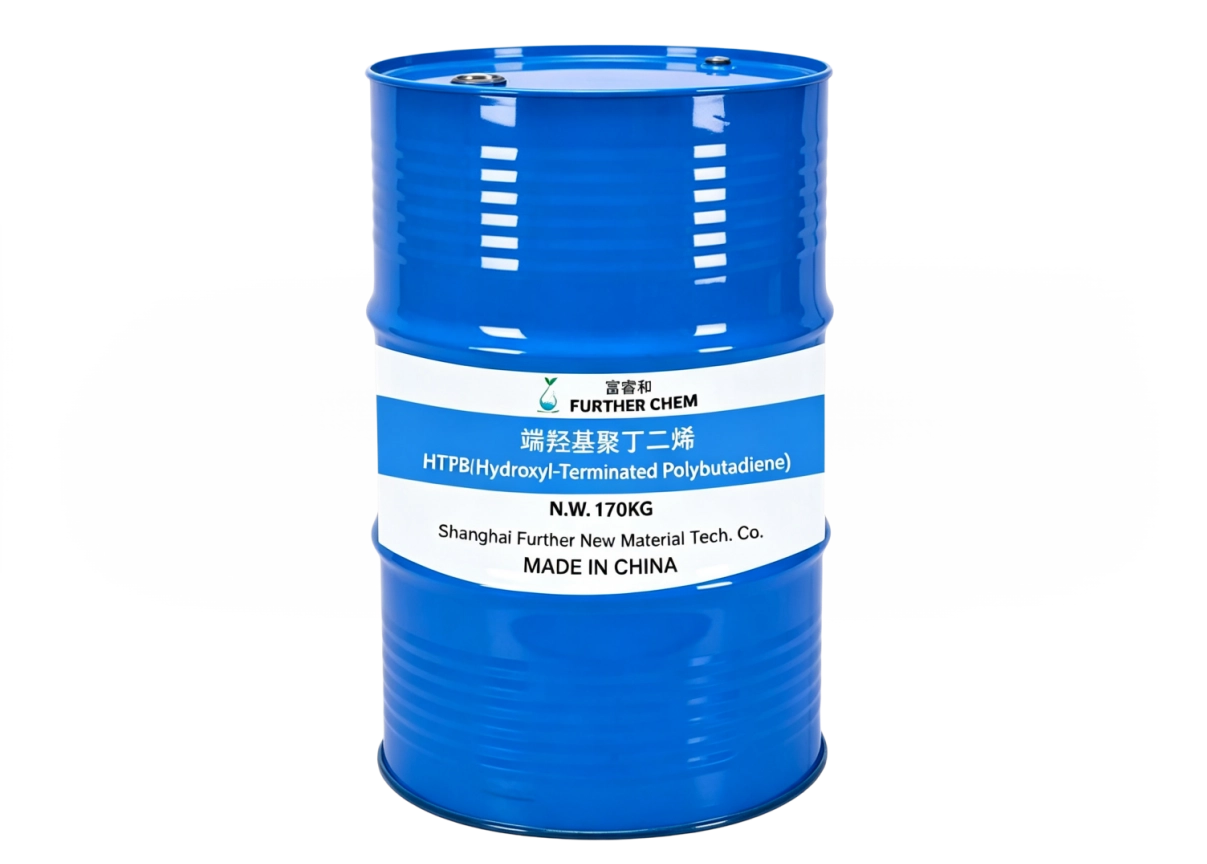
HTPB for Polyurethane Adhesives
Polyurethane adhesives require a different selection approach because hydroxyl functionality can react directly with isocyanates during polyurethane formation.
HTPB provides hydroxyl-terminated polybutadiene chemistry that can be incorporated into polyurethane networks. Its hydroxyl functionality, molecular weight, hydroxyl value, and viscosity influence the NCO/OH balance, network structure, processing behavior, and final mechanical properties.
For polyurethane formulations where reactive liquid rubber is being used to introduce flexibility or improve resistance to repeated deformation, HTPB should be evaluated together with the selected isocyanate and the overall NCO/OH formulation.
Molecular Weight and Functionality Can Change Dynamic Adhesive Performance
Once the chemistry is compatible, molecular architecture becomes one of the most important selection variables. Two liquid rubbers based on similar chemical structures can behave differently because of differences in molecular weight, molecular weight distribution, functionality, and viscosity.
Molecular Weight Affects Viscosity and Rubber-Domain Formation
Molecular weight has a direct effect on viscosity and can therefore influence mixing, dispersion, degassing, dispensing, and coating.
A higher-molecular-weight rubber may require higher processing temperatures or greater mixing energy. If dispersion becomes difficult, the cured adhesive may contain oversized rubber domains or local composition variations that act as weak regions under repeated loading.
At the other end of the range, choosing a lower-viscosity material purely for processing convenience does not guarantee the desired toughening response. The molecular structure still needs to support the phase morphology and mechanical behavior required after cure.
For that reason, molecular weight should be evaluated together with viscosity, rubber loading, resin compatibility, and processing conditions rather than considered as an isolated specification.
Functionality Controls How the Rubber Participates in the Network
Functionality determines how many reactive groups are available for incorporation into the developing polymer network. It can influence crosslink density, network architecture, phase behavior, and the balance between flexibility and cohesive strength.
A monofunctional liquid rubber and a difunctional liquid rubber should therefore not be treated as equivalent materials simply because they have similar backbones.
In polyurethane systems, hydroxyl functionality affects the NCO/OH balance. In epoxy systems, carboxyl- and amine-terminated materials can interact with the resin and curing system in different ways.
The important question is not whether a liquid rubber has a higher or lower functionality in isolation. It is whether its functionality produces the network structure required for the intended dynamic loading condition.
Choose Reactive Liquid Rubber Based on the Type of Dynamic Load
“Dynamic loading” covers several different mechanical conditions. A joint subjected to millions of low-amplitude vibration cycles has a different failure environment from a joint exposed to repeated impact or large peel deformation.
The material selection should therefore be connected to the dominant stress mode.
Cyclic Shear
In cyclic shear, the adhesive layer repeatedly deforms in the shear direction. Local defects and geometric discontinuities can generate stress concentrations that gradually initiate fatigue damage.
A suitable rubber modifier should provide controlled energy dissipation while maintaining adequate cohesive strength. Rubber-domain morphology, matrix modulus, and rubber-matrix interfacial adhesion all influence this balance.
For these applications, cyclic shear or fatigue testing is more informative than a single lap-shear value because the service condition is defined by repeated loading rather than one maximum load.
Peel and Flexing
Peel and flexing produce highly localized deformation, particularly near the edges of bonded areas. Flexible assemblies can therefore require a different modulus-toughness balance from rigid structural joints.
A reactive rubber modifier can help accommodate repeated deformation, but excessive rubber content can lower cohesive strength and increase creep.
The evaluation should reproduce the actual peel rate, temperature, joint geometry, and number of cycles expected during service.
Impact and Shock Loading
Impact loading produces rapid deformation and high local stress. The adhesive needs to dissipate energy quickly enough to prevent unstable crack growth.
For impact-resistant systems, the rubber phase needs to interact effectively with the matrix and create useful energy-dissipation mechanisms without causing excessive loss of stiffness.
Impact strength should therefore be considered alongside fracture behavior and fatigue data rather than used as the only basis for selecting a reactive rubber modifier.
Vibration and Repeated Mechanical Cycling
Vibration can expose an adhesive to very large numbers of relatively small loading cycles. Over time, even small amounts of damage can accumulate and eventually lead to cohesive or interfacial failure.
Relevant variables may include fatigue crack growth, damping behavior, cohesive strength, and the stability of the rubber-matrix interface.
A formulation that performs well in a short tensile or lap-shear test may therefore require additional validation before being used in a long-term vibration environment.
Dynamic Load Type and Reactive Liquid Rubber Selection
Dynamic load | Main concern | Important rubber variables | Useful evaluation |
Cyclic shear | Crack initiation and growth | Functionality, morphology, loading | Fatigue shear and fracture testing |
Peel and flexing | Localized strain concentration | Flexibility, molecular weight, loading | Peel fatigue and repeated flexing |
Impact | Rapid energy absorption | Rubber morphology, matrix interaction | Impact and fracture testing |
Vibration | Long-term fatigue damage | Morphology, damping, cohesive strength | Cyclic fatigue and vibration testing |
Thermal-mechanical cycling | Repeated expansion and contraction | Compatibility, network structure, Tg | Thermal cycling and DMA |
The comparison shows why there is no universal “best” liquid rubber for dynamic adhesives. The appropriate modifier depends on the dominant failure mechanism, adhesive chemistry, joint design, and service environment.
Rubber Loading Is a Performance Variable Not a Simple Toughness Lever
Increasing rubber content does not automatically improve dynamic durability. At low loading, there may be insufficient rubber phase to provide meaningful energy dissipation. At higher loading, excessive soft-phase content can reduce modulus, cohesive strength, thermal stability, and dimensional resistance.
The useful range is therefore normally a formulation window rather than a fixed loading level.
Three factors need to be considered together:
· Rubber loading and the resulting concentration of the dispersed phase
· Rubber-domain size and distribution after curing
· Adhesion between the rubber phase and the continuous polymer matrix
A formulation can contain the “right” amount of rubber and still perform poorly if the rubber domains are too large, poorly distributed, or weakly bonded to the matrix.
Morphology Matters More Than Loading Alone
Dynamic toughening depends strongly on the morphology created during cure. The rubber phase needs to be sufficiently dispersed to interact with developing cracks, while the domain size and interfacial characteristics must remain appropriate for the matrix chemistry.
This is why rubber phase morphology should be treated as a formulation outcome rather than a simple property of the raw material.
Cure temperature, cure rate, resin composition, molecular weight, rubber loading, and processing history can all influence phase separation. Two formulations containing the same liquid rubber can therefore produce different cured structures and different fatigue performance.
Viscosity Can Decide Whether a Toughened Adhesive Is Manufacturable
A rubber modifier that works in a laboratory formulation may still be unsuitable for production if its viscosity creates processing problems.
High-viscosity liquid rubber can increase mixing torque, extend blending time, complicate degassing, and make automated dispensing more difficult. These effects become increasingly important as rubber loading increases.
The practical selection window should therefore include:
· Initial viscosity and viscosity after resin blending
· Required mixing temperature and shear
· Dispensing equipment limitations
· Degassing behavior
· Pot life and storage stability
· Cure kinetics
· Final rubber dispersion
This matters when a formulation moves from laboratory development to industrial production. A material that can be dispersed manually in a small batch may not provide the same consistency in automated mixing or high-throughput dispensing.
Key Parameters to Compare When Selecting Reactive Liquid Rubber
Parameter | Why it matters | Questions to ask |
Terminal functionality | Determines chemical participation in curing | Does it match the adhesive chemistry? |
Molecular weight | Influences viscosity and morphology | Can it be processed at the required loading? |
Molecular weight distribution | Can affect consistency and phase behavior | Is the distribution controlled between batches? |
Viscosity | Directly affects processing | Can the production process handle it? |
Acrylonitrile content | Influences CTBN polarity and interaction | Does the level suit the epoxy formulation? |
Rubber loading | Controls soft-phase concentration | Where is the toughness-processability balance? |
Cure behavior | Determines network development | Does the rubber alter the intended cure? |
Phase morphology | Influences fracture behavior | Is dispersion uniform and reproducible? |
Interfacial adhesion | Affects stress transfer | Will premature debonding occur? |
For industrial procurement, these properties should be supported by reliable batch quality control and consistent analytical data. Supplier-side control of molecular characteristics, functionality, viscosity, and other critical specifications can be just as important as the nominal performance of a single laboratory batch.
A Practical Workflow for Reactive Liquid Rubber Selection
A more reliable selection process starts with the adhesive's service conditions and works backward toward the material specification.
1. Define the dynamic load profile.
Identify whether the joint will experience cyclic shear, peel, impact, vibration, thermal cycling, or a combination of these conditions. Frequency, amplitude, temperature, and expected service cycles should be recorded whenever possible.
2. Identify the dominant failure mode.
Determine whether the primary concern is crack initiation, crack propagation, cohesive failure, interfacial failure, excessive deformation, or fatigue accumulation.
3. Match terminal functionality to the adhesive chemistry.
CTBN and ATBN can be considered for epoxy systems, while HTPB is relevant to polyurethane chemistry. The functional groups need to be evaluated against the complete resin and curing system.
4. Define the processing window.
Set acceptable viscosity, mixing temperature, dispensing conditions, pot life, and cure requirements before selecting the final grade.
5. Screen molecular weight and functionality.
Compare candidates according to molecular weight, molecular weight distribution, terminal functionality, viscosity, and other critical specifications rather than relying only on product names.
6. Optimize loading and cure conditions together.
Rubber concentration, cure schedule, phase separation, and final morphology are interconnected. Changing one variable can shift the performance of the complete formulation.
7. Test under realistic dynamic conditions.
Single-point tensile or lap-shear strength is not sufficient for a dynamic adhesive. Use cyclic, fatigue, peel, impact, vibration, or thermal-mechanical testing that reproduces the expected service environment.
For complex formulations, supplier-side technical support can also be useful when comparing material specifications, processing conditions, and application-specific requirements before moving to larger-scale trials.
This approach reduces the risk of selecting a rubber because it improves one laboratory property while creating problems in processing, network structure, or long-term fatigue performance.
Where Reactive Liquid Rubber Is Most Valuable Under Dynamic Loads
Automotive and Machinery Adhesives
Automotive and machinery assemblies can experience vibration, shock, temperature changes, and repeated mechanical loading. Adhesives used in these environments may require a balance of toughness, fatigue resistance, adhesion, and manufacturing consistency.
The appropriate modifier depends on the adhesive chemistry, substrate, joint geometry, and expected service cycle. A rubber grade should therefore be evaluated in the complete adhesive rather than selected solely from its standalone mechanical data.
Structural and Engineering Adhesives
Structural bonding generally requires high cohesive strength and dimensional stability, so rubber modification needs to be carefully controlled.
The objective is to increase fracture resistance without reducing the load-bearing capability of the cured adhesive beyond acceptable limits. In these systems, adhesive fatigue resistance and crack-growth behavior can provide more useful information than elongation data alone.
Electronics and Electrical Bonding
Electronics and electrical assemblies can experience vibration, thermal cycling, and differential expansion between materials with different coefficients of thermal expansion.
For these applications, rubber modification needs to be considered alongside moisture resistance, thermal behavior, cure shrinkage, electrical requirements, and mechanical compliance.
Industrial Sealing and Flexible Bonding
Flexible bonding and sealing applications often involve repeated deformation rather than one high mechanical load. The formulation may therefore require controlled flexibility and resistance to fatigue damage while maintaining adhesion over long service periods.
Here, the relationship between rubber loading, modulus, recovery, morphology, and cohesive strength becomes particularly important.
The Right Reactive Liquid Rubber Depends on the Load Profile
There is no single specification that defines the ideal reactive liquid rubber for every dynamic adhesive application. The appropriate choice depends on how the adhesive deforms, where damage is likely to initiate, how cracks propagate, and how the rubber phase interacts with the cured matrix.
For epoxy adhesives, CTBN and ATBN provide different chemical routes to rubber modification. For polyurethane systems, HTPB introduces hydroxyl functionality that can participate in network formation. Within each material family, molecular weight, functionality, viscosity, loading, and formulation compatibility can shift the final result substantially.
The most reliable approach is to start with the service load and dominant failure mechanism, then work backward to the required rubber chemistry and formulation parameters. When reactive liquid rubber selection is treated as a system-design problem rather than a simple product comparison, the resulting adhesive can be optimized not only for toughness, but also for processing consistency and long-term performance under repeated mechanical loading.

 English
 English
  Spanish
  Russian
  Arabic
  French
  German
  Portuguese
  Turkish
  Dutch
Dutch  Polish
  Korean
  Vietnamese
  Indonesian
 02. Jul, 2026