What Makes TMI Different from Conventional Functional Monomers?
Many polymer formulations need more than one type of chemical functionality. A coating may require good film formation during application but also stronger chemical resistance after curing. An adhesive may need to retain processability during manufacture while developing a more durable network after bonding. Conventional monomers often address only part of this requirement.
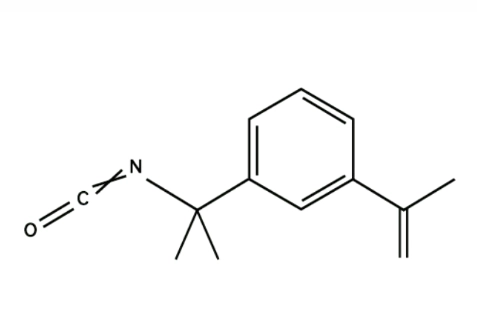
TMI (3-isopropenyl-α,α-dimethylbenzyl isocyanate) offers a way to introduce two distinct reactive functions into one molecular structure. Its isopropenyl group provides a site for incorporation into a polymer chain, while its sterically hindered isocyanate group remains available for subsequent chemical reactions.
This combination makes TMI functional monomers particularly interesting for acrylic polymer modification, reactive latex development and specialty polymer synthesis. The TMI isocyanate functional monomer is designed around this dual-function chemistry, allowing formulators to introduce isocyanate functionality during polymer synthesis rather than relying entirely on a separately added crosslinker.
The distinction is important: TMI is not just another isocyanate crosslinker. It can act as a functional monomer during polymer synthesis and provide residual reactive sites for later modification or curing.
The Dual-Functional Structure of TMI
TMI is identified by CAS No. 2094-99-7 and is also known as 3-isopropenyl-α,α-dimethylbenzyl isocyanate. Its molecular design combines an unsaturated group with an aliphatic isocyanate group attached to a sterically hindered carbon center.
These two groups perform different jobs.
The Isopropenyl Group Anchors TMI into the Polymer
The carbon-carbon double bond in the isopropenyl group allows TMI to participate in TMI copolymerization with suitable vinyl monomers. Depending on the polymerization route and monomer combination, TMI can be incorporated into an acrylic or other vinyl-based polymer structure.
Common comonomer families include:
Acrylic and methacrylic esters, such as methyl methacrylate and butyl acrylate, for adjusting hardness, flexibility and film-forming behavior.
Styrenic monomers, which can contribute rigidity and influence polymer compatibility.
Other suitable vinyl monomers selected according to the target polymer composition and polymerization process.
Once incorporated, TMI-derived units become part of the polymer structure. The isopropenyl group has served its purpose in chain incorporation, while the NCO functionality can remain available for further reaction.
The Isocyanate Group Provides a Second Reaction Opportunity
The NCO group is the feature that distinguishes TMI from many conventional vinyl monomers. It can react with suitable active-hydrogen compounds, including primary and secondary amines, hydroxyl-containing materials and other compatible functional groups.
This creates a route to introduce additional chemical connections after the polymer backbone has been formed.
For example, an acrylic polymer containing pendant NCO groups can react with an amine-functional compound during a subsequent curing or modification step. The resulting chemical structure can differ substantially from an acrylic polymer that relies only on physical blending with a conventional additive.
The two-stage concept can be summarized as follows:
| Functional group | Main role | Formulation significance |
|---|
| Isopropenyl group | Copolymerization with suitable vinyl monomers | Introduces TMI-derived units into the polymer |
| Isocyanate group (NCO) | Subsequent reaction with compatible functional compounds | Enables further modification or crosslinking |
The practical value lies in controlling when each function is used. Polymer incorporation and subsequent crosslinking are separate chemical events, and the formulation needs to preserve that distinction.
How TMI Enables Reactive Polymer Modification
The most useful way to understand TMI is to follow what happens during polymer development, rather than treating it as a conventional crosslinker added at the end of formulation. This is the central principle behind reactive polymer modification using a dual-functional monomer.
Step 1: Incorporating Functional Groups During Polymerization
TMI can be copolymerized with suitable vinyl monomers to produce a polymer containing pendant isocyanate functionality. In an acrylic latex, for example, the selected monomer composition determines the balance between film-forming characteristics and the amount of reactive functionality introduced.
The TMI concentration matters. Too little may provide insufficient functionality for the intended downstream reaction. Too much can affect polymerization behavior, colloidal stability and the properties of the resulting film.
The polymerization process must also account for the sensitivity of isocyanate groups to moisture. Although the sterically hindered NCO group in TMI has improved relative stability in aqueous environments compared with less hindered isocyanates, it is not immune to hydrolysis.
Temperature, pH, monomer feed strategy, surfactant selection and reaction time should therefore be assessed as part of the complete latex design. These factors are particularly relevant when developing TMI for acrylic latex modification.
Step 2: Preserving NCO Functionality After Incorporation
Successful copolymerization does not automatically guarantee that all intended NCO groups remain available.
Water can react with isocyanate groups, eventually producing amine-containing intermediates and carbon dioxide, with further reactions potentially forming urea linkages. Other ingredients in the formulation may also consume NCO functionality before the intended curing stage.
For this reason, the residual NCO content should be considered alongside monomer conversion and polymer composition.
Useful checks include:
FTIR analysis to monitor the characteristic isocyanate absorption band and assess changes during processing.
NCO content measurement to estimate the remaining reactive functionality.
Particle-size and storage-stability testing for latex systems, particularly when changes in pH or formulation composition are involved.
These measurements help distinguish between a polymer that contains TMI-derived units and one that still retains enough accessible NCO groups to deliver the intended post-reaction.
Step 3: Activating the Second-Stage Reaction
After polymer synthesis, the remaining NCO groups can be used in a separate reaction step.
Depending on the application, this may involve amine-functional compounds, polyols or other compatible reactants. The reaction can introduce additional bonding between polymer chains, link the polymer to another component, or provide a route to surface modification.
For coatings, the objective may be to increase network integrity after film formation. For adhesives, the formulation may be designed to develop stronger cohesive structure after application. In either case, the reaction must be matched to the available functional groups and the required processing window.
Where TMI Functional Monomers Add Practical Value
The advantage of TMI is not that it automatically improves every polymer property. Its value comes from giving formulators another way to control polymer architecture and introduce reactive sites at a defined stage of synthesis.
Acrylic Latexes and Waterborne Coatings
One important application is the modification of acrylic latexes. By incorporating TMI into the polymer, manufacturers can create latex particles with isocyanate functionality available for subsequent film-forming reactions.
As water evaporates and the coating develops, suitable NCO-reactive compounds can contribute to additional network formation. Depending on formulation design, this can help improve film strength, scrub resistance and resistance to chemical or mechanical exposure.
However, the presence of NCO groups alone does not guarantee improved coating performance. Their accessibility, distribution within the latex particle, reaction partner and curing conditions all influence the final result.
A useful development program should compare the modified latex with an otherwise similar control formulation, using the same application thickness and curing conditions. This is also relevant when evaluating TMI in industrial coatings, where film integrity and long-term exposure resistance are important performance criteria.
Industrial Adhesives and Sealants
In adhesive formulations, polymer modification is often aimed at improving cohesive strength without making the material too brittle or difficult to process.
TMI-derived NCO functionality can provide additional reaction sites for compatible amine- or hydroxyl-functional components. This offers a way to adjust network formation beyond what can be achieved through the initial vinyl polymer composition alone.
The choice between incorporating reactive functionality during polymer synthesis and adding a crosslinker during formulation depends on the resin chemistry, curing conditions and required processing window. These considerations are also important when evaluating polyisocyanate crosslinkers for industrial adhesive systems, although their role in the formulation differs from that of a polymerizable functional monomer.
The formulation should be evaluated for both initial handling and final bond performance. Relevant tests may include viscosity, open time, tack development, lap-shear strength, peel resistance and water or heat aging, depending on the adhesive's intended use.
Plastic Surface Modification
TMI can also be used in polymer grafting and surface modification approaches. When introduced into a grafted polymer structure, the remaining isocyanate groups can provide sites for reaction with other functional materials.
This is relevant when a polymer surface needs improved interaction with coatings, adhesives or other materials. The actual result depends on grafting efficiency, surface accessibility and the chemical nature of the material used in the subsequent reaction.
Specialty Polymer Synthesis
Beyond conventional coatings and adhesives, TMI can be considered when designing specialty polymers that require both vinyl-based incorporation and later chemical modification.
Potential development directions include functional latexes, polymerizable surfactant systems, reactive polymer intermediates and selected thermosetting or heat-curable formulations. These applications require formulation-specific validation; they should not be treated as interchangeable uses with identical reaction conditions.
Key Formulation Factors When Working with TMI
A successful TMI-based formulation depends on preserving the intended reaction sequence. The following variables deserve particular attention.
| Formulation variable | Why it matters | What to evaluate |
|---|
| TMI concentration | Determines the potential density of reactive sites | Polymerization rate, residual NCO and final film properties |
| Polymerization temperature | Influences reaction kinetics and NCO stability | Conversion, side reactions and functional-group retention |
| Water exposure | Can consume isocyanate functionality | Storage stability and residual NCO |
| pH and surfactant system | Affect latex stability and reaction environment | Particle size, coagulum and shelf stability |
| Secondary reactant | Determines the subsequent reaction pathway | Functional-group compatibility and cure response |
| Curing conditions | Control the extent of post-reaction | Film formation, crosslink development and final performance |
Managing the Balance Between Functionality and Stability
A higher concentration of TMI may increase the number of potential reaction sites, but it can also make the system more difficult to manage. Polymerization behavior, latex stability and final film properties may all change as the TMI content increases.
The correct concentration should therefore be established experimentally rather than selected solely to maximize NCO content.
Similarly, a formulation designed for ambient curing will have different requirements from one intended for thermal curing. The reaction partner, film thickness, humidity and curing temperature all influence the extent and rate of network development.
Choosing the Right Evaluation Methods
For customers developing TMI-modified polymers, a useful evaluation program should connect chemical measurements with application performance.
A practical sequence is:
Characterize the starting material. Confirm TMI identity, purity and NCO content against the relevant product specification.
Evaluate polymer incorporation. Monitor conversion and determine whether the polymerization process retains the intended functionality.
Check storage stability. Track viscosity, particle size, appearance and residual NCO over the required storage period.
Assess the secondary reaction. Compare curing behavior and film or bond properties with an appropriate control formulation.
Validate under service conditions. Test water resistance, chemical exposure, mechanical durability or other application-specific requirements.
This approach helps identify whether a performance change comes from polymer composition, retained functionality or the final crosslinking reaction.
TMI Compared with Conventional Isocyanate Crosslinkers
TMI and conventional isocyanate crosslinkers both provide NCO chemistry, but they are introduced into polymer systems in different ways.
A conventional crosslinker is generally added to an existing polymer or resin formulation to react with available functional groups. TMI, by contrast, can be incorporated into a polymer through its unsaturated group before the remaining NCO functionality is used in a later reaction.
| Comparison | TMI functional monomer | Conventional isocyanate crosslinker |
|---|
| Main role | Introduces NCO functionality during polymer synthesis | Provides crosslinking functionality during formulation or curing |
| Incorporation route | Copolymerization or suitable grafting process | Physical addition followed by chemical reaction |
| Timing of NCO use | Can be retained for a subsequent reaction | Usually reacts after addition to the formulation |
| Main design consideration | Polymerization compatibility and NCO retention | Crosslinker compatibility, stoichiometry and pot life |
| Typical development focus | Functional polymer or latex design | Curing and network formation |
Neither approach is universally better. TMI is particularly relevant when the desired functionality needs to be built into the polymer structure. A conventional crosslinker may be more appropriate when a manufacturer wants to modify an existing resin without changing its polymerization route.
Selecting TMI for a Polymer Modification Project
Before selecting TMI, formulators should define the intended reaction sequence and the properties that need to change. The most important questions are not simply how much NCO the monomer contains, but how the NCO functionality will be introduced, preserved and used.
A project assessment should establish:
Whether the base polymer is suitable for copolymerization or grafting with TMI.
Whether the polymerization medium and process conditions can preserve sufficient NCO functionality.
Which secondary reactant will consume the remaining NCO groups.
Whether the target is improved film strength, adhesion, chemical resistance, surface functionality or another measurable property.
What storage and application conditions the final product must tolerate.
For formulators developing isocyanate-functional acrylic polymers or other specialty polymer systems, TMI provides a route to incorporate isocyanate functionality directly into a polymer structure. This is particularly relevant to TMI for adhesive modification, where the polymer may need to retain processability before developing additional network structure during curing.
Its suitability should be assessed against the intended polymerization method, moisture exposure, required residual NCO content and subsequent reaction partner. These factors determine whether the functionality introduced during synthesis remains available for the intended modification or curing step.
TMI belongs to the broader range of adhesive intermediates and specialty isocyanates supplied by Shanghai Further New Material Technology Co., Ltd. The appropriate grade and formulation approach depend on the target polymer and processing requirements.
Putting TMI to Work in Polymer Design
The main advantage of TMI lies in the separation of two chemical functions within one molecule. Its isopropenyl group enables incorporation into suitable vinyl-based polymers, while the remaining isocyanate group creates an opportunity for further reaction after polymer synthesis.
For acrylic latexes, coatings, adhesives and specialty polymers, this approach gives formulators another way to control where reactive groups are introduced and how they participate in subsequent network formation.
The result depends on more than the amount of TMI added. Polymerization conditions, NCO retention, reaction partner compatibility and curing behavior all need to be considered together. When these variables are properly controlled, TMI becomes a useful building block for developing polymers with tailored reactive functionality.

 English
 English
 Spanish
 Russian
 Arabic
 French
 German
 Portuguese
 Turkish
 Dutch
 Polish
 Korean
 Vietnamese
 Indonesian

 02. Jul, 2026